 View notices
English football’s £9bn empire teeters on financial brink
English professional football is facing a mounting financial crisis despite generating more than £9 billion in annual revenue, with 94% of clubs across the country's top five divisions operating at a loss.
A report released on Tuesday by England's Independent Football Regulator (IFR) found that the sport's extraordinary commercial popularity has masked widespread financial instability, excessive spending and dependence on wealthy club owners.
Reuters reported that nearly two-thirds of English Football League and National League clubs are technically insolvent, with liabilities exceeding the book value of their assets.
Even among Premier League clubs, approximately 20% fall into that category.
The findings raise serious questions about the sustainability of a football industry that attracts enormous international audiences, lucrative broadcasting agreements and substantial investment from overseas owners.
The regulator found that 17 clubs would remain loss-making even if their players received no salaries.
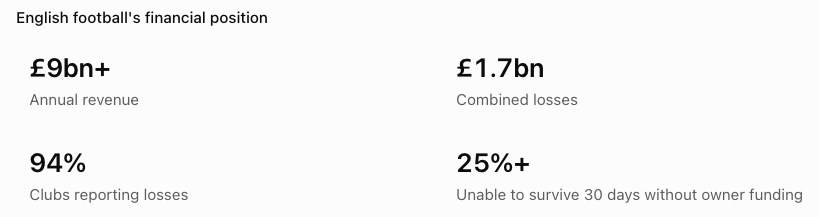 Photo: AI-generated
More than a quarter of clubs would be unable to survive for longer than 30 days if their owners withdrew financial support.
The findings suggest that clubs are spending heavily to remain competitive, often without generating enough income to sustain their operations independently.
For lower-division teams, the pressure is particularly acute because revenue from broadcasting, sponsorship and commercial activities is substantially smaller than that available to Premier League clubs.
The financial divide creates incentives for clubs to spend beyond their means in pursuit of promotion, which can provide access to significantly greater revenue.
However, unsuccessful promotion campaigns and relegation can leave clubs with financial obligations they struggle to meet.
IFR chairman David Kogan warned that the financial position of many clubs exposed them to serious risks if owners withdrew their support.
The regulator has proposed a six-point reform programme, including stronger financial controls, contingency planning and measures intended to improve long-term sustainability.
The Premier League has acknowledged the need for reform while supporting solutions developed within football.
It has proposed contributing £1.8 billion over 10 years to the English Football League as part of broader revenue-distribution arrangements.
The regulator's draft findings are subject to an eight-week public consultation.
The report also comes amid continued scrutiny of Manchester City's alleged breaches of Premier League financial rules, although those proceedings are separate from the wider findings on the sport's financial condition.
Despite English football's global commercial success, the report suggests that revenue growth alone has not translated into financial stability.
The underlying problem is a business model in which competitive ambition, rising costs and dependence on external funding have left much of the professional game financially exposed.
Sources: Reuters, Independent Football Regulator, State of the Game, Anadolu Agency.