 View notices
Undersea cable fears grow as Iran threatens Gulf digital infrastructure
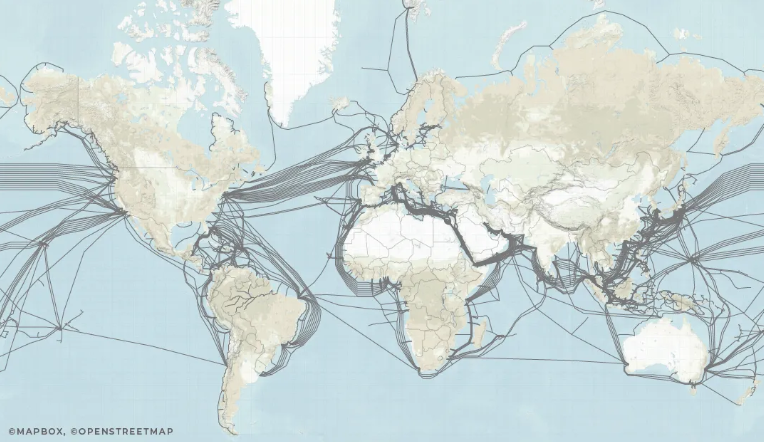
Iran has warned that data centres, artificial intelligence facilities and critical communications infrastructure across the Middle East could become military targets in any renewed conflict with the United States, raising concerns about the vulnerability of internet connections linking Europe, Asia and Africa.
The warning by Iranian security chief Mohsen Rezaei comes amid renewed fighting in Yemen, where control of territory around the strategically important Bab al-Mandeb Strait remains contested.
Nils Adler reported for Al Jazeera that the escalating confrontation has exposed a potentially serious vulnerability in the global digital economy, with substantial volumes of international data travelling through undersea cables concentrated in the Red Sea.
According to telecommunications research firm TeleGeography, more than 90% of data capacity between Europe and Asia passes through cables beneath the Red Sea. Many of these cables traverse Bab al-Mandeb, a narrow maritime passage between Yemen and the Horn of Africa, about 26km wide at its narrowest point. The concentration of communications infrastructure in such a strategically sensitive corridor means that damage to relatively few cables could disrupt connectivity across multiple countries.
Digital infrastructure emerges as military target
Iran has repeatedly identified Western technology companies and their regional infrastructure as potential targets since hostilities involving the United States and Israel began earlier this year. On 11 March, Iran’s semi-official Tasnim news agency reported that the Islamic Revolutionary Guard Corps (IRGC) had identified cloud infrastructure belonging to Google, Microsoft and Oracle in Israel and Gulf states among potential targets. The IRGC subsequently named 17 American companies, including Google, Meta and Apple, alongside the Emirati artificial intelligence company G42.
Rezaei’s latest warning suggests that technology infrastructure could play an increasingly prominent role in future military confrontation. Andreas Krieg, senior lecturer in security studies at King’s College London, told Al Jazeera that the threat should be taken seriously, although Iran’s ability to cause significant disruption should be distinguished from its capacity to systematically destroy the Gulf’s digital infrastructure.
He said Rezaei’s warning was particularly significant because it did not simply threaten another set of targets but identified a new category of strategic infrastructure linking Gulf economic diversification directly to American technological power.
Krieg characterised the warning as a form of deterrence directed not only at Washington but also at Gulf governments, which have invested heavily in American technology partnerships. By threatening the infrastructure supporting those investments, Tehran could seek to increase regional pressure against further American military intervention.
Data centres vulnerable to relatively limited attacks
Unlike dispersed telecommunications networks, major data centres are large, fixed facilities that depend on continuous electricity, cooling and communications services. Krieg said an attack would not necessarily have to destroy computer servers to render a facility inoperable.
Disruption to power supplies, cooling systems or telecommunications connections could be enough to interrupt services supporting banking applications, cloud computing and artificial intelligence operations.
The risks are not hypothetical. In March, Amazon Web Services (AWS) reported that two of its facilities in the United Arab Emirates had been directly struck by drones, while an attack near another facility in Bahrain caused physical damage to its infrastructure. Abu Dhabi Commercial Bank subsequently experienced an interruption to its banking application during a wider regional IT disruption, although the bank did not directly attribute the outage to AWS. In September, AWS said it remained unable to restore several affected sites in Bahrain and one in the UAE.
Krieg said the attacks demonstrated the limitations of relying on national air defence systems to protect commercial technology infrastructure. Gulf militaries can intercept most incoming threats, he said, but even a small number of successful strikes can have disproportionate economic consequences. Relatively inexpensive drones can threaten facilities containing equipment worth billions of dollars, creating an imbalance between the cost of an attack and the potential economic damage.
Red Sea cables face growing exposure
The threat to undersea telecommunications infrastructure has become particularly concerning as fighting intensifies around Bab al-Mandeb. The Iran-backed Houthi movement seized the port of Mocha and surrounding territory in September, extending its influence along the Red Sea coastline.
On 11 September, Houthi forces reportedly reached Mayyun Island, which divides the strait into two channels. Yemen’s internationally recognised government subsequently claimed on 5 October that its forces had recaptured Mocha and positions near the strait. The Houthis disputed those claims, leaving the military situation contested.
Although the Houthis have attacked commercial shipping, there is no confirmed evidence that they have deliberately targeted undersea internet cables. The group has denied responsibility for cable damage recorded in 2024. Nevertheless, the risks to submarine infrastructure are substantial.
In February 2024, three cables were damaged in the Red Sea, most likely after being struck by the dragging anchor of the Rubymar, a cargo vessel disabled by a Houthi missile. According to industry reporting cited by Data Center Dynamics, repairs took several months.
In September 2025, two further cables were damaged near Jeddah in Saudi Arabia, slowing internet connectivity across parts of the Middle East and South Asia. The cause of those incidents has not been established. Repairing damaged submarine cables in conflict zones can be especially difficult because specialist vessels require safe access, government permits and security assurances.
Alternative routes gaining importance
The growing vulnerability of Red Sea communications infrastructure has accelerated efforts to develop alternative terrestrial and submarine connections between Europe and Asia. On 10 September, Iraq signed an agreement with Qatar’s telecommunications company Ooredoo to carry international data traffic across Iraqi territory.
The proposed underground route runs from al-Faw in southern Iraq to Rabia near the Turkish border, providing an alternative to cables passing through the Red Sea. On 7 October, Ooredoo’s international division agreed to acquire fibre capacity from Iraq’s iQ Networks to extend connectivity towards Turkey, subject to regulatory approval.
Technology companies are also exploring alternative routes. Rest of World reported on 7 October, citing an unnamed source, that Google and Meta had begun routing some traffic through Iraq. Neither company had confirmed the arrangement when approached by Al Jazeera. Microsoft, meanwhile, announced in September that it intended to invest more than $400m in submarine and terrestrial communications infrastructure across the Middle East by 2030. Krieg said genuine resilience would require geographically dispersed infrastructure, potentially including facilities outside the Gulf.
Gulf’s AI ambitions face security challenge
The threats come as Gulf governments invest heavily in artificial intelligence, cloud computing and digital infrastructure as part of efforts to diversify their economies beyond oil and gas. In Abu Dhabi, G42 is developing Stargate UAE in partnership with OpenAI, Nvidia and other companies, as part of a planned five-gigawatt UAE–US artificial intelligence campus.
Saudi Arabia’s Public Investment Fund launched Humain in May 2025, with Crown Prince Mohammed bin Salman as chairman, to develop data centres and Arabic-language artificial intelligence capabilities. Qatar’s sovereign wealth fund joined American investment company Blue Owl in a $3bn data centre initiative in September 2025. Microsoft has also announced plans to invest more than $10bn across Kuwait, Qatar, Saudi Arabia and the UAE by 2030, with greater emphasis on digital resilience.
However, the attacks have demonstrated that large technology investments do not necessarily guarantee operational security. Krieg said the security risks were unlikely to reverse the Gulf’s technological ambitions but could influence where infrastructure is built and how investment decisions are made.
The Gulf has traditionally sold itself as a stable environment in an unstable region, he said, a proposition the war has challenged. He suggested that the UAE was particularly exposed because of its close technological integration with American companies, while Qatar’s diplomatic relationship with Iran could provide some political insulation.
Implications extend to African connectivity
The risks are not confined to the Middle East. South African businesses and financial institutions depend on international telecommunications networks for cloud computing, banking transactions, data storage and cross-border commercial services.
Although South Africa has submarine cable connections through both the Atlantic and Indian oceans, disruption to major Europe-Asia routes can affect international traffic management, network capacity and service reliability. For logistics companies, banks and multinational businesses, the potential consequences include higher communications costs, reduced network resilience and interruptions to digital services.
The broader concern is that infrastructure supporting the international digital economy is becoming increasingly exposed to geopolitical confrontation. As Krieg observed, Iran’s strategy could make the reliability of the Gulf’s emerging digital economy a bargaining instrument, much as regional conflict has already affected maritime trade and energy markets.