 View notices
Storm warnings from 5,000 light-years away
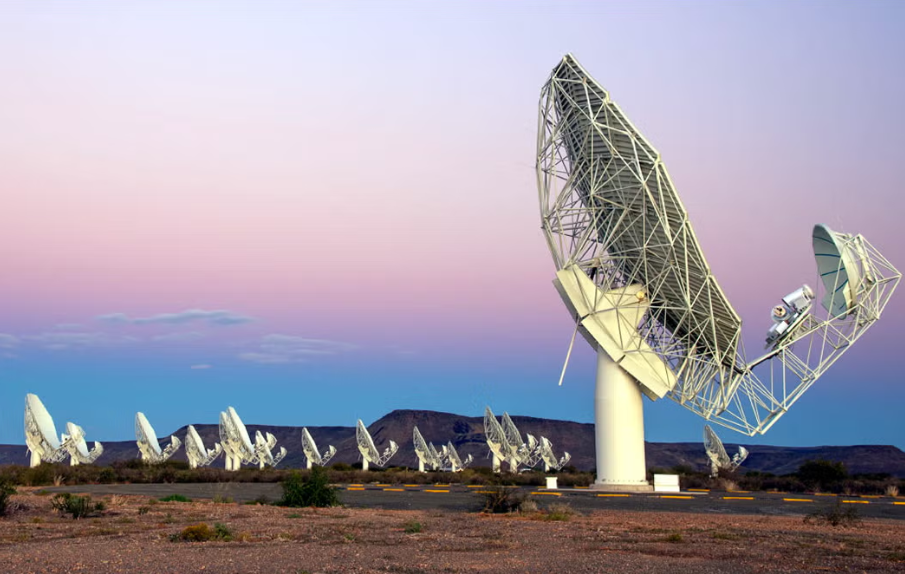
A dead star that sends out radio pulses roughly every eight minutes has been found orbiting a Sun-like star, with South Africa’s MeerKAT telescope helping to pin down where it sits in the sky.
The system, known as GPM J071507−114153, pairs a white dwarf, the dense core left behind when a star dies, with a G-type star similar to our Sun.
Researchers at the Curtin University node of the International Centre for Radio Astronomy Research (ICRAR) in Australia say it is the first time radio pulses have been detected from a white dwarf circling a Sun-like star. Such pulses had previously been seen mainly in systems with smaller, cooler red dwarf companions. The study was published in Nature Astronomy.
The signal was first picked up in Australia by the Murchison Widefield Array (MWA), which has been scanning the part of the Milky Way visible from there. Associate Professor Natasha Hurley-Walker said the team then turned to MeerKAT, run by the South African Radio Astronomy Observatory in the Northern Cape, to establish the source’s precise position. The W.M. Keck Observatory in Hawaii then confirmed through optical observations that the companion is a Sun-like star.
The object belongs to a class known as long-period transients, whose radio signals switch on and off over minutes to hours. Around a dozen have been found since the same team discovered the first in 2021, and astronomers are still trying to understand them.
Until now it was unclear which star in such pairs produced the pulses.
Lead author Sam McSweeney, now a commissioning scientist at the Square Kilometre Array Observatory, said this is the first time the pulses were clear enough to show the white dwarf moving in its orbit. That means they come from close to the white dwarf, or possibly from the white dwarf itself. The team processed more than 100 hours of radio data at the Pawsey Supercomputing Research Centre to confirm the motion.
The pulses also revealed flares on the Sun-like star, similar to the eruptions that cause aurorae on Earth. The white dwarf was also seen passing behind a region of strong magnetic field, most likely a large loop of plasma rising from the star’s surface.
McSweeney said that if precursor telescopes can already make such finds, the full SKA telescopes should uncover many more. MeerKAT and the MWA are precursors to the SKA-Mid in South Africa and SKA-Low in Australia respectively.
Sources: Curtin University, Gizmodo, Phys.org.