 View notices
Extra body weight linked to longer survival after dementia diagnosis

Older people who are overweight or obese when diagnosed with dementia may survive significantly longer than those in the normal weight range, according to an American study that challenges conventional assumptions about body weight and health in later life.
Researchers analysing data from more than 4,500 people found that higher body weight at the time of diagnosis was associated with a substantially lower risk of death, even after accounting for several health conditions and lifestyle factors.
The findings, published in the Journal of Alzheimer's Disease, were reported by SciTechDaily and add to growing evidence that the relationship between body weight, ageing and dementia is more complicated than previously understood.
The research examined 4,523 participants in the Health and Retirement Study, a nationally representative investigation of American adults aged 51 and older conducted by the University of Michigan.
All participants were free of dementia when they entered the study but subsequently developed the condition. Using data collected between 1998 and 2022, researchers examined changes in body weight before diagnosis and survival outcomes afterwards. Relative mortality-risk differences observed in the study, not proof that higher weight causes longer survival.
The findings appear to contradict established research showing that obesity during middle age increases the risk of developing dementia. However, the researchers emphasised that the two findings were not necessarily incompatible. Body weight may influence the likelihood of developing dementia differently from how it affects survival once the disease has been diagnosed.
Researchers examine possible statistical bias
One difficulty in interpreting dementia research is that patients may begin losing weight years before the condition is formally diagnosed. Earlier research by Virginia Chang and Yuan Zhang found that weight loss could begin as much as a decade before diagnosis, accelerating during the years immediately preceding it.
This raises the possibility that some patients classified as having a normal weight at diagnosis had previously been heavier and had already experienced substantial disease-related weight loss.
Other potential distortions include survivor bias, where people with obesity who live long enough to develop dementia may be healthier than others who had similar body weights earlier in life.
The researchers conducted additional analyses to examine these possibilities but found little evidence that the major biases investigated explained the observed survival differences.
“Because this finding is somewhat counterintuitive, an important question is whether it could simply be an artifact of bias,” said Zhang, assistant professor of sociomedical sciences at Columbia University's Mailman School of Public Health.
“Our analyses suggest that the major sources of bias we examined do not explain the survival advantage associated with higher weight.”
Nutritional reserves may play a role
One possible explanation is that people carrying additional body fat or muscle mass have greater physiological reserves when dementia begins interfering with eating and nutrition.
Dementia can affect brain processes that regulate hunger, appetite and food intake, while progressively making it more difficult for patients to prepare meals or feed themselves. Some patients also experience increased energy expenditure and substantial loss of muscle and body tissue.
“Nutrition can be a big problem for people with dementia,” Chang said.
“They may experience wasting and an inability to eat, which can be due to changes in the brain's central drive, leading to loss of appetite and initiative, increased energy expenditure, and difficulties feeding themselves.”
Additional body reserves may help some patients tolerate periods of inadequate nutrition, although the study did not establish that this mechanism explains the survival advantage.
Findings do not support deliberate weight gain
The researchers cautioned against interpreting the findings as evidence that people with dementia should attempt to gain weight.
The study was observational and examined associations between existing body weight and survival. It did not test whether deliberate weight changes could improve outcomes.
“This doesn't mean that patients with dementia should attempt to become overweight or obese, as our study was not designed to test that question,” Chang said.
“But our findings do suggest that weight status may serve as a useful prognostic signal for survival at the time of dementia diagnosis.”
Chang, associate professor of social and behavioural sciences at New York University's School of Global Public Health and the study's lead author, said the findings also reinforced the importance of nutrition in dementia care.
Researchers believe further investigation is needed to determine whether fat stores, muscle mass, nutritional status or other physiological factors account for the association.
The study nevertheless suggests that body weight at diagnosis could provide clinicians with useful additional information when assessing patients' likely health outcomes.
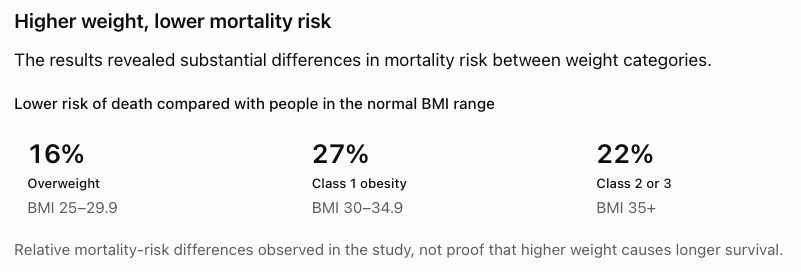 Photo: AI-generated
Sources: SciTechDaily, Journal of Alzheimer's Disease, University of Michigan Health and Retirement Study, Columbia University Mailman School of Public Health, NYU School of Global Public Health.