 View notices
Can we still think for ourselves?
Tomorrow’s local government elections raise an important question: can we still think for ourselves?
Or are we increasingly reliant on agency avoidance, asking AI: “Howdy, partner, who should I vote for tomorrow?”
That’s assuming, of course, we haven’t relinquished this distinctly human ability long ago. One only has to think of Stanley Milgram’s experiments, which began in 1961 and showed how readily people could obey instructions to hurt others rather than apply some on-the-spot moral decision-making.
It reminds me of what a friend in the fiduciary business said the other day: Anthropic has apparently said that a fair number of Claude’s “clients” like to exchange pleasantries.
How are you, thanks, how about coming over later for some virtual drinks – that sort of thing.
My first response was: are you for real?
But I can believe it, as I have heard from more than one person how AI is increasingly leaned on for companionship, which, of course, is somewhat sad and a little too reminiscent of something out of Black Mirror.
What’s more disturbing, though, is the agency part, and it’s not always about important decisions, such as box-crossing on a ballot paper.
Take this past Saturday, on the final day of the third Test against Australia at Newlands.
South Africa had only moments earlier clinched the Unbreakable series 2-1 when a boy dashed across the pitch, grabbed a memento stump and made a daring bob-and-weave sprint back to the stands.
Two security guards tried to stop him, but he deftly sliced through them like a Cheslin Kolbe protégé.
A third security guard came flanking in along the boundary – executive overhang notwithstanding – as if he was about to take a catch, but the stump-snatcher bailed over the boundary barrier and seemed safe.
What followed was just another example of how we often fail to think for ourselves. The boy was ‘retrieved’ and carried off by some security guard – I think it was the bloke with the boep – holding him aloft by an arm and a leg.
The crowd started chanting, “Let him go, let him go!”, but the boy was marched off despite remonstrations by at least two different guys, one presumably his father. At least by this time he was on his feet, his arm firmly clutched by a senior-looking guard who was clearly just doing his job.
This boy’s attempt at securing a bit of sport memorabilia is the stuff of human spiritedness, and yes, had he not been apprehended, then some suit or middle-management curmudgeon would probably have wanted to know from his minions why they failed.
Surely, having got to the boy, it would’ve sufficed to take the stump and let it be. But no, the child had to be subjected to the relevant security protocol.
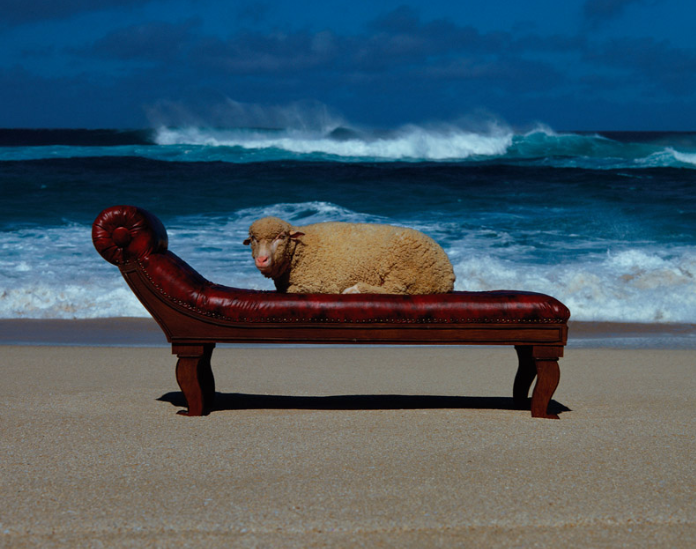
It made me think of a poster a friend had on a wall, of a sheep on a chaise longue, on a beach with breaking surf in the background. It said: “Are you normal?”
It was also used by way-back-when band 10cc for an album cover called Look Hear?, and is probably more relevant than ever before.
Perhaps the most important message it sends out is tongue-in-cheek: why be normal? Or maybe it’s about not being a sheep on a couch, too lazy to think for yourself.
So when you make your cross on 4 November, remember that herd behaviour should’ve been stumped out long ago.