 View notices
A pause, not a pivot: what the SARB's split vote means
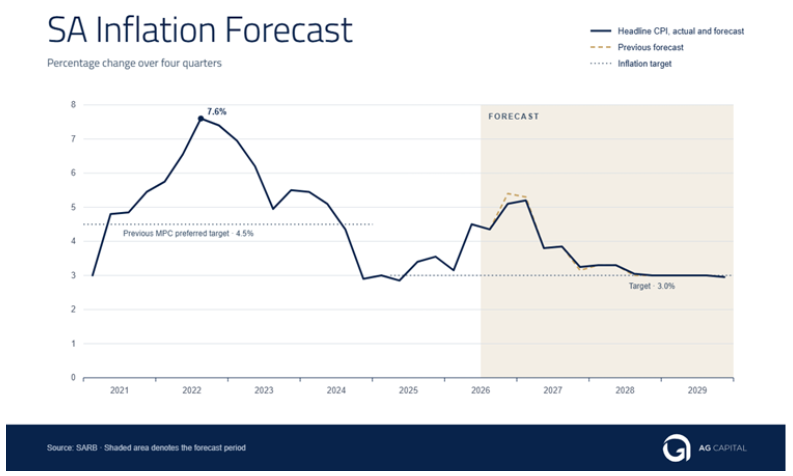
The South African Reserve Bank left the repo rate unchanged at 7.25% at its November MPC meeting, in line with market expectations.
The vote however, was close: four members of the Monetary Policy Committee supported a hold and three wanted a 25bp hike, so one vote separated a pause from another increase.
A 4–3 split is about as close as a decision can be, reflecting a dilemma central banks across the world are wrestling with. They must decide whether to move pre-emptively against an energy shock, or wait for firmer evidence that higher fuel prices are filtering into the broader basket of goods and services.
If the SARB moves too early, it tightens into a fragile economy. If it waits too long, inflation expectations can drift higher, and that eventually demands a bigger response.
We expect that tension to stay with us for some time. Inflation has been highly volatile, driven largely by the oil price, which makes the near-term path for rates unusually difficult to call.
Governor Kganyago offered the most useful guidance during the media Q&A, when he noted that every member agreed on the direction of rates and differed only on the pace. We read that as a committee with a clear tightening bias, whose debate centres on timing.
Our baseline is one further 25bp hike in January, which would take the repo rate to 7.50%.
Several data points will shape that call:
- US Federal Reserve rate expectations, and what they do to the rand. A weaker currency quickly feeds into imported inflation.
- The inflation expectations survey on 15 December. It will show whether businesses, unions and analysts are starting to build higher fuel costs into their own pricing and wage demands.
- Second-order effects showing up in the monthly CPI releases.
- The energy price shock and the El Niño weather pattern, both of which pose risks to food and transport costs.
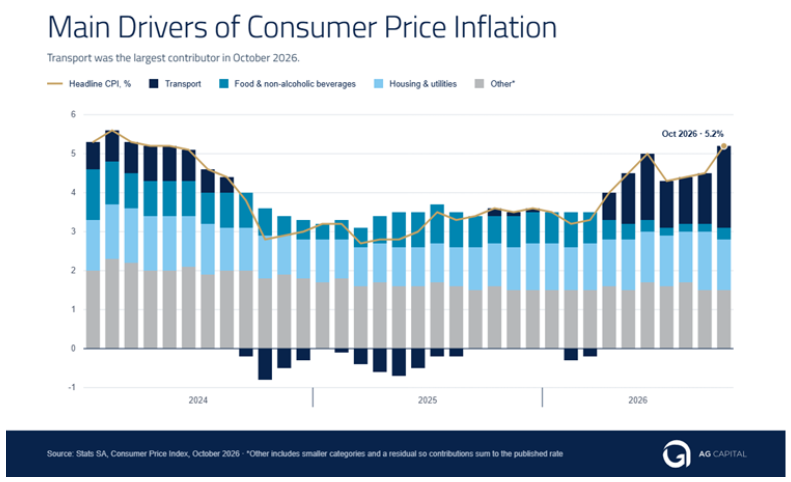 Photo: AG Capital
On growth, the Bank left its forecasts unchanged at 1.2% for 2026, 1.7% for 2027, 1.9% for 2028 and 2.0% for 2029. These are modest numbers for an economy that needs considerably faster growth to make headway on unemployment and the public finances.
The MPC still sees the risks to medium-term growth tilted to the downside. Potential growth remains weak, and the small negative output gap narrows only gradually over the forecast horizon.
This is what makes the SARB's position so uncomfortable. In most economies, growth below 2% alongside spare capacity would argue for lower rates. South Africa's structural constraints in electricity, logistics and investment keep the economy's speed limit low.
Even a modest pickup in demand, or a supply shock of the kind we are seeing in fuel, can therefore put pressure on prices. The Bank has, in effect, chosen to protect its inflation credibility and accept a softer recovery as the cost.
Scenarios point to upside inflation risks
The bank's scenario analysis again focused on upside risks to inflation, which fits with the three votes for a hike. In the first scenario, oil rises to US$130/bbl and refinery margins widen.
Inflation then averages above 5%, and the bank would need another 50bp of tightening in 2027. In the second scenario, fiscal risks push up bond yields and the country's risk premium. The rand weakens, inflation picks up by a similar amount, and the policy response is much the same.
Both scenarios are a useful guide to how the SARB is likely to react. It will probably meet any shock that threatens inflation expectations with tighter policy, whether that shock comes from imported oil or from fiscal slippage at home.
For households, the hold buys a little time. The prime rate remains at 10.75%, and a January hike would lift repayments on mortgages and vehicle finance at a point when fuel and food already absorb a larger share of monthly budgets.
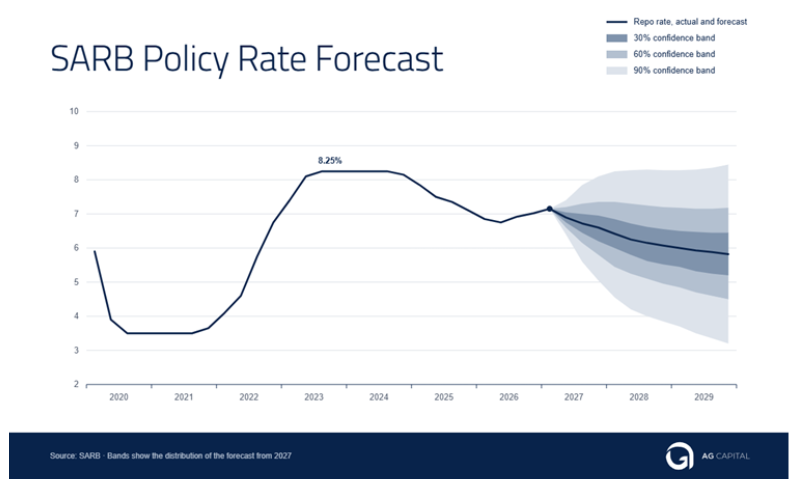 Photo: AG Capital
Consumer spending carries most of the economy's growth, so we expect the strain to show in retail activity during the first quarter. Businesses face a similar calculation. Higher borrowing costs and an uncertain demand outlook tend to push investment decisions further out, and unfortunately that works against the very potential growth the economy lacks.
For markets, the hold was fully priced, so the vote split and the guidance carry more weight than the decision itself. The short end of the bond curve should stay anchored to a January hike, while longer-dated yields remain sensitive to the fiscal risks the Bank has flagged.
A central bank prepared to tighten offers the rand some support, although the Fed and the oil price are likely to remain the dominant drivers. In equities, rate-sensitive sectors such as retail, listed property and domestically focused financials may struggle while the tightening bias persists. For active managers, a market driven by policy expectations, oil and fiscal headlines creates the dispersion across and within asset classes that relative-value and long/short strategies are built to exploit.
The bottom line
The SARB has paused, and it is still leaning towards tighter policy. The bar for rate cuts stays high until the energy shock eases and inflation expectations settle. The risk of further hikes stays high too. Investors should prepare for a central bank that will accept weaker growth to protect its credibility on inflation.
 Photo: AG Capital