 View notices
US debt tops $40 trillion as Hormuz takes its toll
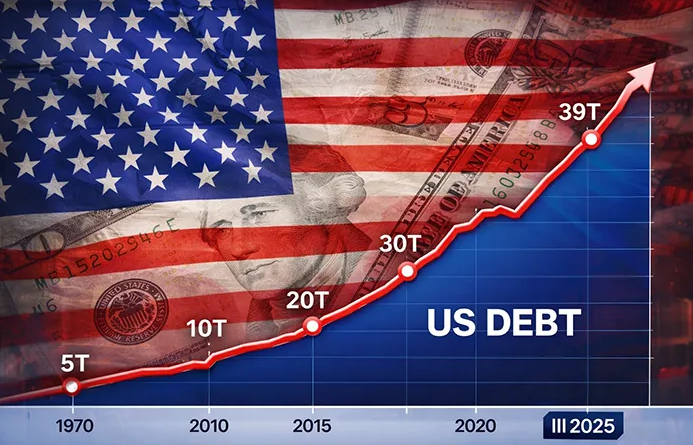
The United States government's total debt has passed the $40 trillion mark for the first time, the Treasury Department confirmed this week, as Washington continues to fund an expensive, open-ended military presence in the Strait of Hormuz.
Treasury data showed the debt reaching $40.05 trillion, roughly four and a half years after it first passed the $30 trillion threshold. A decade ago, in January 2017, the debt stood at $19.95 trillion – meaning the figure has effectively doubled in under ten years.
The milestone has prompted fresh warnings from economists and budget watchdogs that a fiscal crisis may be brewing, as the costs of social safety-net programmes and interest payments continue to outstrip government revenue.
Treasury reported the fourth-highest monthly deficit in US history for July, at $432 billion, with tariff refunds pushing customs receipts negative for a third consecutive month while Social Security and Medicare outlays kept climbing. Interest payments on the debt have reached roughly $1.1 trillion so far this year, now the second-largest line item in the federal budget after Social Security.
The $40 trillion figure works out to about $117,000 in debt for every person in the US, or roughly $297,000 per household – a sum the Peter G. Peterson Foundation estimates is comparable to the combined economies of China, Germany, Japan, the United Kingdom and India.
A costly commitment in the Gulf
Part of the wider spending picture this year has been a sustained American military effort to keep the Strait of Hormuz open to shipping, after Iran moved to close the waterway earlier in 2026.
The US launched an aerial campaign against Iranian naval vessels and drones on 19 March, aimed at reopening the strait, followed by a naval blockade of Iran from 13 April. US Central Command (Centcom) has said the blockade – which has intercepted 85 vessels and seized three ships, according to the command's own figures – is costing Iran approximately $500 million a day.
In early May, the US launched Operation Project Freedom, a military operation to escort merchant ships through the strait, though the operation was temporarily halted after just a day. Centcom said the operation would draw on guided-missile destroyers, more than 100 land- and sea-based aircraft, and multi-domain unmanned platforms, though exactly how those assets would get merchant traffic moving again was not fully spelled out at the time.
More recently, attention has turned specifically to the strait's southern channel. Increased activity by US military support and surveillance aircraft over the Persian Gulf in early August suggested Washington was again working to facilitate passage through the southern part of the strait without Iranian oversight.
A prospective tanker-escort force built around Aegis-equipped destroyers – reportedly including the USS Mahan, USS Winston Churchill, USS Bainbridge and USS Thomas Hudner – would rely on those ships' ability to track and intercept missile and drone threats, alongside embarked MH-60 Seahawk helicopters used for reconnaissance and minesweeping. That kind of sustained, high-end naval deployment does not come cheap, though the operation's precise cost to the US has not been broken out separately in Treasury's own accounting of the deficit.
Not a direct cause – but part of a wider strain
Analysts caution against drawing too direct a line between the Hormuz operation and the debt milestone. The Washington Post reported that the $40 trillion figure was reached in part because of lost revenue from tariffs that were struck down by the courts, while CNN and other outlets have pointed to an ageing population driving up Social Security and Medicare costs, along with tax cuts including the 2017 Tax Cuts and Jobs Act and 2025's so-called One Big Beautiful Bill Act, as the more significant long-term drivers of the debt's growth.
Military spending in the Gulf – however costly in absolute terms – is one strand among several contributing to a deficit shaped mainly by entitlement spending, tax policy, and the compounding cost of servicing debt that is now over $40 trillion and rising.
Sources: The Washington Post, CNBC, CNN, Al Jazeera, NBC News, ABC News, USNI News, Wikipedia (2026 Strait of Hormuz campaign, 2026 Strait of Hormuz crisis, Operation Project Freedom, 2026 United States naval blockade of Iran), WANA News