 View notices
State to hand 2.5m hectares to emerging farmers
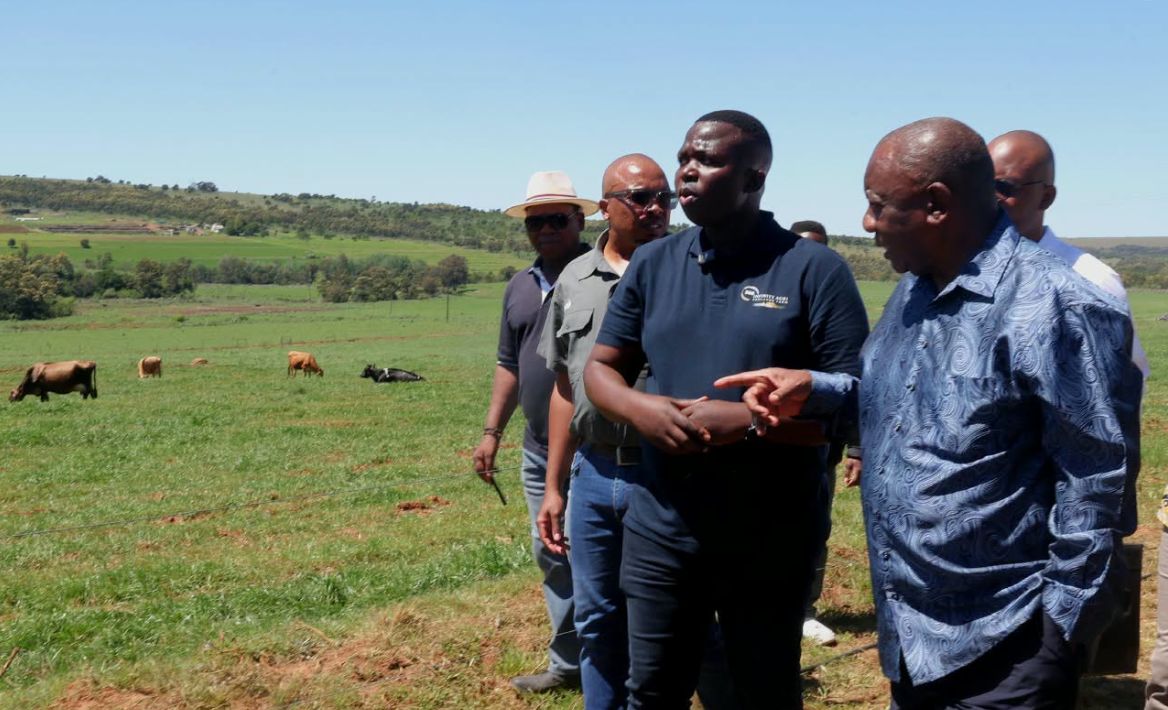
President Cyril Ramaphosa has called for an accelerated transformation of South Africa’s agricultural sector, arguing that greater participation by black commercial farmers is essential to expanding food production, creating jobs and securing the country’s long-term food supply.
However, the president’s assessment of the racial composition of commercial agriculture has drawn scrutiny, with questions surrounding the statistics used to describe land ownership and agricultural output.
In his weekly newsletter on Monday, Ramaphosa highlighted a recent visit to Redlands Farm, a commercial dairy operation in Stutterheim in the Eastern Cape, as an example of how access to finance can help emerging farmers establish commercially viable businesses.
The farm, owned and operated by young black farmers, has expanded with support from the Land Bank’s Blended Finance Scheme, which combines government grants with loan financing.
Ramaphosa said many emerging farmers remained confined to subsistence agriculture because they lacked access to capital for equipment, infrastructure, agricultural inputs and additional land.
He argued that improving access to finance, technical expertise and markets would allow more farmers to participate in commercial agriculture.
Agricultural success masks inequalities
South Africa’s agricultural sector has more than doubled in size since 1994 and remains an important contributor to employment, exports and economic activity.
According to figures cited by Ramaphosa, the sector employs approximately 944,000 people directly, with another 200,000 employed across the broader agricultural value chain.
Agricultural exports reached a record R270 billion in 2025, placing South Africa among the world’s 32 largest agricultural exporters.
Products exported include citrus, maize, beef, wine, table grapes, sugar and wool, with African markets accounting for nearly half of the country’s agricultural exports.
Ramaphosa attributed the sector’s growth partly to improvements in seed breeding, animal genetics, agricultural technology and farming efficiency.
Despite these advances, he argued that the benefits of commercial agricultural growth had not been distributed evenly.
“We still have what has been called ‘two agricultures’,” Ramaphosa said, referring to the divide between established commercial farming operations and emerging farmers.
He claimed that predominantly white-owned commercial farms accounted for most agricultural output, while black farmers contributed approximately 10%.
The president maintained that dependence on a relatively small section of the population for commercial food production was unsustainable, particularly as South Africa’s population and demand for food continued to grow.
Questions over the numbers
Business Tech, however, has drawn attention to the sources underlying Ramaphosa’s assessment, noting that claims about who produces South Africa’s agricultural output and who owns its farmland have previously been subjected to scrutiny.
The publication referred to fact-checking work examining the composition of agricultural production, as well as academic research into farmland ownership.
While BusinessTech did not establish that the president’s figures were incorrect, its observations highlight the importance of distinguishing between land ownership, agricultural production and participation in commercial farming.
These are related but different measures, and figures concerning one cannot necessarily be used to establish the position of another.
The distinction is significant in a sector where debates about land reform, historical ownership patterns, productivity and food security remain closely intertwined.
Ramaphosa nevertheless maintained that broadening participation in commercial agriculture was necessary to sustain future production and address historical inequalities.
Government plans to release 2.5 million hectares
Central to the government’s agricultural transformation programme is a plan to release approximately 2.5 million hectares of state-owned land to black farmers through the Proactive Land Acquisition Strategy.
Ramaphosa said beneficiaries would receive title deeds, giving them more secure ownership and potentially improving their ability to obtain financing. He argued that access to land alone would not guarantee commercial success.
Emerging farmers also needed practical training, mentorship, agricultural technology, market access and knowledge of crop management, weather conditions and animal diseases. The president acknowledged the role of established agricultural organisations in providing technical support and developing new commercial farmers.
He singled out the Citrus Growers’ Association, Grain South Africa, National Wool Growers’ Association, Potatoes South Africa, Red Meat Industry Services, Milk Producers’ Organisation and Fruit South Africa for their contribution to agricultural development.
Banks urged to increase funding
Ramaphosa also called on commercial banks and agribusinesses to expand their participation in blended finance programmes.
The Land Bank and Department of Agriculture introduced the blended finance instrument to address funding constraints facing emerging commercial farmers, with commercial banks subsequently joining the initiative.
The president wants additional lenders and agricultural businesses to develop financing mechanisms that provide affordable, longer-term capital.
Government is also pursuing new agricultural export markets and engaging industry participants on advances in biotechnology, breeding techniques and other technologies intended to improve productivity.
A 2025 University of Pretoria study cited by Ramaphosa found a strong correlation between agricultural investment and poverty reduction, supporting the argument that farming development could contribute to rural economic growth.
However, the effectiveness of the proposed expansion will ultimately depend on whether access to land and finance translates into sustainable commercial production.
The challenge extends beyond increasing the number of black commercial farmers to ensuring that new entrants have the infrastructure, expertise, capital and market opportunities needed to compete in an increasingly demanding agricultural economy.
With agriculture already a major export earner and employer, the success of the programme will be measured not only by the extent of land redistribution but also by its contribution to productivity, employment and food security.