 View notices
SARS closes the gap on undeclared income
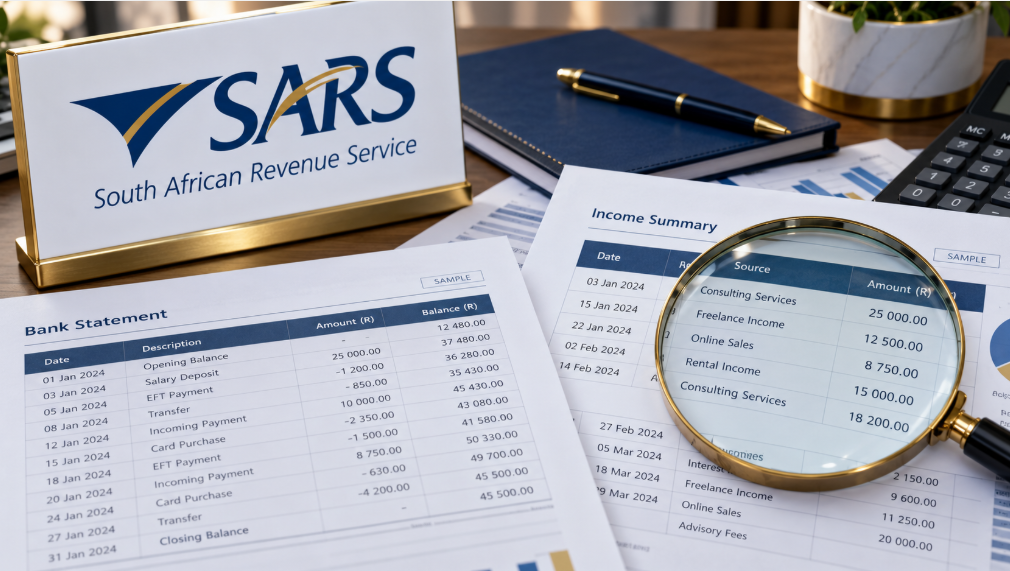
Taxpayers can no longer safely assume that income omitted from their returns will escape detection as the South African Revenue Service (SARS) builds a more complete picture of their financial affairs.
Roxanna Naidoo, director of Global Strategy at tax advisory firm Latita Africa, told Jeremy Maggs on the Moneyweb@Midday podcast that third-party reporting, international information sharing and increasingly automated administration were narrowing the gap between what taxpayers disclosed and what SARS could establish independently.
Modern tax authorities were moving beyond reliance on self-declaration followed by audits of a relatively small proportion of taxpayers, she said.
SARS’s use of data, artificial intelligence and intelligent case management meant discrepancies between declared income, financial records and information supplied by other institutions were becoming increasingly risky.
Naidoo cited unexplained bank deposits, offshore income missing from returns and inconsistencies in company records as examples of matters taxpayers should not assume would remain unnoticed.
She said the shift involved increasingly routine information matching, rather than investigations directed only at selected individuals.
Bank interest and investment income could already be reflected in third-party submissions, while international information-sharing arrangements provided visibility of certain offshore financial assets. Crypto-related reporting was also expanding.
The central question was therefore changing from what taxpayers had told SARS to whether their declarations agreed with other available information about them.
For salaried employees whose returns accurately reflected their earnings and other income, Naidoo said the developments were not necessarily cause for concern. However, taxpayers needed to abandon the assumption that SARS knew only what they chose to disclose.
Her comments reflect SARS’s stated modernisation strategy. At September’s Tax Indaba, the revenue service outlined plans involving digital identity capabilities, intelligent case management, automation and AI to improve service and make enforcement more precise.
Asked about financial privacy, Naidoo pointed to the importance of appropriate AI use and human intervention, describing the purpose of the systems as collecting tax legitimately owed to the fiscus.
She also cautioned against treating a possible revenue improvement of about R50 billion or more above the February budget forecast as a permanent increase in government’s spending capacity.
The figure remained an estimate, she said, and stronger commodity prices could account for part of any improvement. Such gains could reverse while underlying economic growth remained weak.
Naidoo favoured using an unexpected revenue increase to strengthen the deficit and debt position rather than immediately committing government to additional permanent expenditure.
She distinguished between raising tax rates and collecting more of the tax already due. Better recovery of outstanding debt and detection of undeclared income, offshore assets and reporting discrepancies could improve revenue without further increasing rates for compliant taxpayers.
VAT administration is another area facing substantial change.
Naidoo said the traditional approach of assembling information at the end of a VAT period was giving way to more structured reporting closer to the time transactions occurred.
SARS’s proposed Digital VAT Model combines electronic invoicing and reporting to support near real-time flows of VAT information. Its published guidance envisages phased implementation from 2030, subject to consultation, approvals and readiness, rather than an immediate blanket requirement.
SARS acknowledges that businesses could face software, service-provider, training and other implementation costs. Its proposals allow for smaller businesses to join later and potentially use simpler accounting packages or service-provider portals.
The intended benefits include improved fraud detection, better risk assessment and, over time, pre-filled returns and greater automation. Whether those benefits outweigh the transition costs for smaller businesses will depend on the final design and implementation.
Sources: Moneyweb@Midday, Jeremy Maggs interview with Roxanna Naidoo (19 October), transcript supplied; SARS, Tax Indaba statement, 14 September; SARS, VAT Modernisation FAQs, updated 11 September.