 View notices
Risk expert questions safety margins on Airlink's stadium flyover
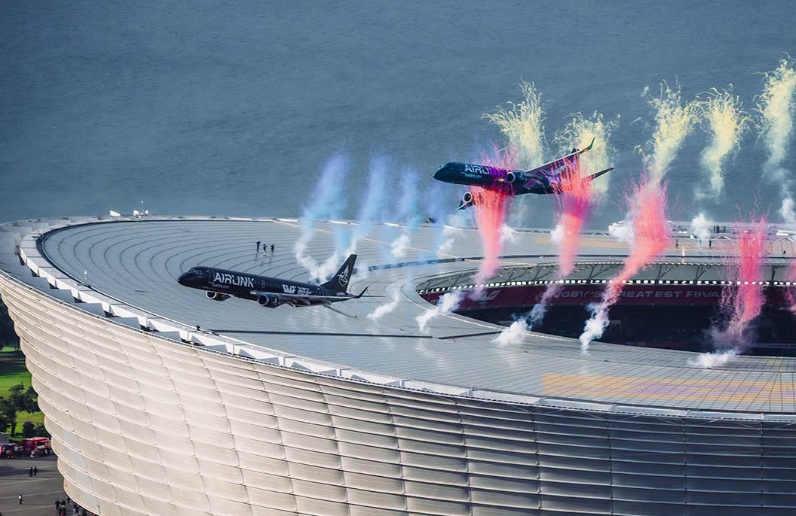
Airlink's formation flyover ahead of Saturday's second Test between the Springboks and All Blacks was too low and reflected poor risk management, according to aviation risk consultant Volker von Viddern of Riskonet Africa – a view that stands in contrast to the airline's own assurances that the manoeuvre was conducted safely.
The Springboks' official airline sponsor issued a statement on Sunday defending the flyby over Cape Town's DHL Stadium, after footage of the two aircraft went viral on social media and drew public concern, according to SAnews.gov.za.
Airlink said the flight had required extensive planning and rehearsal given that it involved navigating at low altitude at roughly 150 knots, and that the South African Civil Aviation Authority and Air Traffic Navigation Services had provided guidance and approval throughout.
The airline said both aircraft were flown by highly experienced crews, each staffed by three senior captains acting as commander, co-pilot, and safety or technical officer, and that flight data from both aircraft confirmed the flypast had stayed within the altitude and speed limits agreed and rehearsed with the Civil Aviation Authority beforehand.
But speaking to Jeremy Maggs on his Moneyweb@Midday podcast, Von Viddern argued that regulatory approval alone did not account for the unknowns involved in flying so low over a packed stadium.
He raised the risk of other aircraft or objects in the airspace, warning that a drone being flown to capture footage of the match could potentially have been drawn into one of the engines, with catastrophic consequences.
He also noted that because the aircraft were heading towards Table Mountain, a pilot would have had little room to manoeuvre to safety had something gone wrong directly above thousands of spectators.
Von Viddern said those responsible for approving the flyover needed to guard against any adverse outcome at all costs, given what he described as a high level of avoidable risk in the circumstances.
He characterised the approach as a form of “wilful blindness”, saying: “It's about ticking the boxes, but not executing on risk. And one has to be very careful about that.”
Asked whether a necessary safety margin had been breached, he said it should be established whether factors such as birds and Cape Town's microclimate had been properly accounted for, and argued that no flyover of this kind should have dropped below 50 feet above the stadium roof.
According to analysis by Flightradar24, the lower of the two aircraft came in at between 41 and 46 feet above the stadium roof during the manoeuvre.