 View notices
Poor service delivery fuels ANC decline at the ballot box
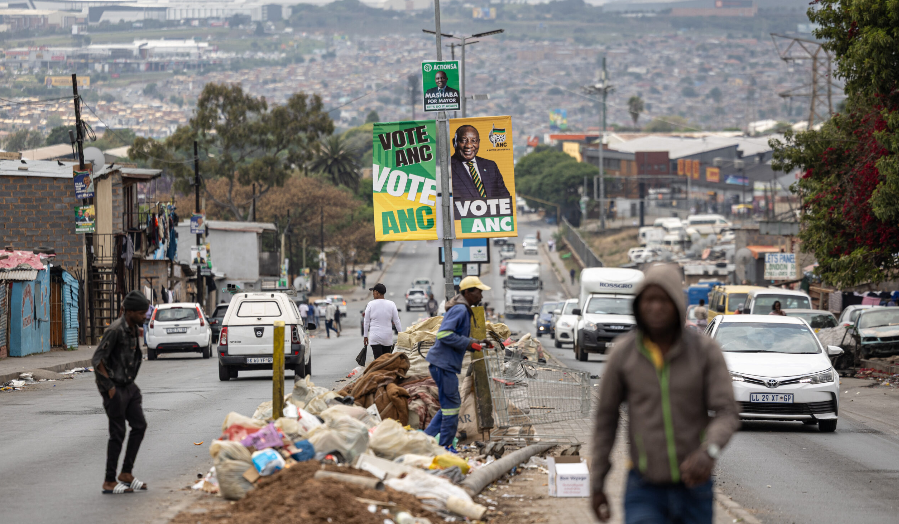
South Africa is shifting away from decades of ANC electoral dominance towards a more competitive and fragmented multiparty system, after the party of Nelson Mandela recorded its poorest showing in a local government poll.
The African National Congress remains the country’s largest party, but Wednesday’s vote appeared to confirm a steady decline driven by long-standing anger over corruption and poor service delivery.
That is more than three decades after it led the country out of apartheid. The party’s secretary-general, Fikile Mbalula, described the outcome as catastrophic, Federica Marsi reports for Al Jazeera.
Voters were choosing councillors for South Africa’s eight largest cities, as well as its 44 district and 205 local municipalities.
The ANC took 31% of the vote, against about 25% for its main rival, the Democratic Alliance. That compares with 46% at the 2021 local elections and 66% in 2006. It lost its place as the largest party to the DA in Johannesburg, Pretoria and Ekurhuleni, while the DA held on to Cape Town, the country’s second-biggest city.
The DA, which rejects the label of a “white party”, said its own modelling showed it had won the votes of more than a million Black South Africans for the first time, Marsi writes.
President Cyril Ramaphosa, who also leads the ANC, urged parties to approach coalition negotiations with humility. He said the interests of the people should not be sacrificed to the pursuit of political scores or petty squabbles.
The result follows the ANC’s loss of its parliamentary majority in the 2024 national election, which ended three decades of dominance and produced a coalition national government. In 1994, under Mandela, the party won 63% of the vote.
Because no party secured an outright majority in many cities, the ANC and DA must either work together or strike deals with smaller parties to form municipal governments.
Parties have 14 days to negotiate before councils are constituted.
An ANC–DA arrangement would mirror the one that has governed nationally for the past two years, although the parties are ideologically opposed on how to tackle the economic and social inequality left by apartheid. The DA is expected to be wary. Analysts say voters punished the ANC over irregular water supply, power cuts, crumbling roads, broken street lights and uncollected refuse.
The DA said in a statement that it would open coalition talks with parties committed to clean and accountable government, rooting out corruption, service delivery for all, the rule of law and non-racialism. That was read as a signal that it would steer clear of the ANC.
Ramaphosa was also penalised over the so-called Farmgate scandal, which stems from a 2020 burglary at his private ranch in which $580,000 hidden in furniture was stolen. He was accused of covering up the theft and keeping efforts to trace the thieves private to avoid scrutiny of the money’s origins.
Sandile Mnguni, a political science lecturer at the University of KwaZulu-Natal, said the slide should serve as a warning that the ANC can no longer count on its historical dominance or liberation credentials. He added that the party could face even tougher contests if voters’ grievances remain unaddressed.
Political commentator Ralph Mathekga said the vote sent a strong message that the collapse of service delivery and the corruption that accompanied it had become intolerable. Voters, he said, now regard the ANC as the chief culprit rather than the solution, and the poll amounted to a referendum on its capacity to govern.
Analyst Sipho Seepe viewed the result as a personal rebuke of Ramaphosa, who has presented himself as a politically astute, business-minded leader but has repeatedly been accused of underperforming. Ramaphosa is expected to step aside as ANC leader ahead of the party’s 2027 leadership contest and the 2029 general election.
Seepe said coalitions should now be accepted as the new normal. That may bring some instability, he said, but could pressure parties to put performance first once in power. The ANC’s government had been stable, he noted, but it had been failing the people.
Mathekga, author of The ANC’s Last Decade, said voters do not want power concentrated in a single party, and that coalitions are likely to stay until parties prove they can be trusted to govern alone. He described the change as a necessary evolution of South African politics.
Mnguni agreed that the country seemed ready to trade a little stability for greater accountability. He cautioned that stalemates, shaky alliances and delayed municipal decisions were real risks, but said the broader shift offered an opportunity for democratic development, provided parties put governance ahead of narrow partisan interests.
Source: Al Jazeera.