 View notices
Low turnout and split votes could cost DA control of Joburg – Zille
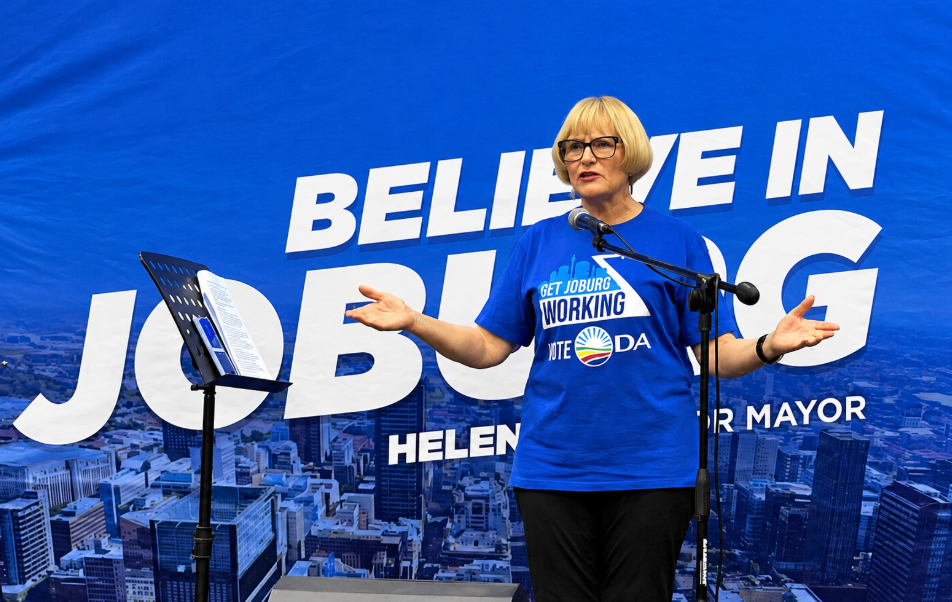
Democratic Alliance mayoral candidate Helen Zille has warned that voter complacency in traditionally blue-run wards, combined with supporters splitting their votes between ballots, could undermine the party’s prospects of an outright majority in Joburg.
Addressing residents in Fontainebleau, Randburg, on Wednesday evening, Zille said the DA’s greatest electoral danger in the local government elections on 4 November was not necessarily losing established strongholds, but failing to attract enough voters to strengthen its overall representation in the metropolitan council.
She argued that supporters who assumed their ward councillor would be re-elected regardless of turnout were overlooking the importance of ward votes in determining the overall composition of the council.
“And in this election, we’re going to win or lose on turnout,” she said.
Zille identified traditionally DA-supporting areas including Bryanston, Ferndale and Fontainebleau as particularly important to the party’s prospects. She said low participation in these areas could deprive the DA of votes needed to increase its proportional representation (PR) in the 270-seat council.
Fontainebleau turnout illustrates the danger
Referring to a February ward by-election, Zille said turnout in Fontainebleau had fallen to approximately 7% of registered voters. The Independent Electoral Commission (IEC) of South Africa recorded turnout of 17.62% across Ward 102, which includes Fontainebleau, Bryanston and Bordeaux, and the DA retained the seat with 94.8% of the vote.
The IEC has not published a separate figure for Fontainebleau, so the 7% could not be independently confirmed.
Zille described the figures as evidence of the complacency affecting established DA strongholds. According to her, voters who considered a DA ward victory inevitable did not appreciate how their absence could affect the party’s overall seat allocation.
“Now, if that happens, we lose scores, literally scores of seats on the proportional ballot,” she said.
She urged residents to persuade friends and family members to vote, even if doing so meant changing holiday arrangements.
Why voting on both ballots matters
In metropolitan municipalities such as Johannesburg, voters receive two ballot papers: one to elect a ward councillor and another to support a party. The council’s 270 seats are divided equally, with 135 ward councillors and 135 proportional representation councillors.
Under the Municipal Structures Act, the votes a party receives on both the ward and PR ballots are added together to determine its overall share of council seats. The ward seats it has already won are then subtracted, and the balance is filled from its party list.
Zille said this meant a vote for a party’s ward candidate counted both in the ward contest and in the party’s proportional-representation total.
“So your ward vote is counted twice: once in the ward race, and again in the party’s total, together with its PR-list votes. You cast two votes, but your ward vote carries weight in two calculations.”
Her explanation was intended to demonstrate why abstention could be damaging even in wards where the DA was expected to win comfortably.
Splitting votes could strengthen smaller parties
Zille also warned against voting for a DA ward councillor while supporting another party on the PR ballot. She referred to a voter who intended to back the DA’s ward candidate but cast a party-list vote for the Freedom Front Plus.
“And I said, don’t do that. Because that splinters the vote again, and it brings down our total.”
She argued that splitting votes reduced the DA’s opportunity to accumulate sufficient support to govern without coalition partners, and pointed to the growing number of smaller parties contesting municipal elections. Zille cited a figure of at least 77 parties on Johannesburg’s proportional representation ballot. The IEC’s final candidate list has 75 parties contesting the city’s proportional representation seats, still the highest of any municipality.
She maintained that although smaller parties might struggle to win ward contests, their combined support across the city could translate into council seats, making it harder for a single party to secure an outright majority.
DA targets 136 seats to govern alone
Zille told residents that the DA needed 136 seats to command a majority in the 270-member council.
“If we get 490,000 people in Joburg to come out and vote for the DA on both ballots, we will get 136 seats,” she said.
The figure is the DA’s own projection. Daily Maverick reported that in 2021 the DA received 482,653 votes in Johannesburg and won 71 seats, with the party using its 2016 performance as a benchmark for a majority. How many seats a given number of votes yields depends on total turnout, the ward results and the allocation formula.
Opinion polls suggest an outright majority remains out of reach. The Sunday Times reported that an eNCA/MarkData survey put the DA at 35% and the ANC at 21.8% among likely voters, while News24 reported that a News24/SABI Strategy Group poll put the DA at 29%. Both leave the party short of the 50% needed to govern alone.
Zille argued that a majority would allow the DA to implement its plans for municipal finances, water, electricity and infrastructure without continuous negotiation with coalition partners. She blamed the city’s repeated changes of political leadership on unstable coalitions and suggested that smaller parties could exercise influence disproportionate to their electoral support.
“We get coalitions because people split their votes. And I hope that Joburg has learnt the very hard lesson of chaotic coalitions and what that brings.”
Coalition instability central to DA campaign
Zille portrayed the election as an opportunity to end Johannesburg’s cycle of unstable administrations. She argued that coalition governments had made long-term programmes difficult to implement, particularly where parties disagreed over appointments, spending priorities and the allocation of municipal responsibilities. She said an administration with a stable majority would be better placed to restore financial discipline, improve water and electricity provision and attract private investment.
The assertion that smaller parties are principally responsible for coalition instability is the DA’s political interpretation. Coalition outcomes also depend on negotiations, party leadership, governance decisions and the willingness of larger parties to cooperate. Voting for a smaller party is not necessarily a wasted vote under proportional representation, since it can secure representation for interests that might otherwise be excluded.
Zille’s argument was instead that consolidating support behind the DA offered the party its strongest prospect of governing without coalition partners. Her appeal highlighted its central campaign objective: turning established voter support into an outright majority rather than another fragmented council requiring coalition negotiations.
Sources: Helen Zille (address to residents, Fontainebleau, 21 October 2026); Electoral Commission of South Africa; Daily Maverick; News24; Sunday Times.