 View notices
Johannesburg's ageing pipes bleed a third of the city's water supply
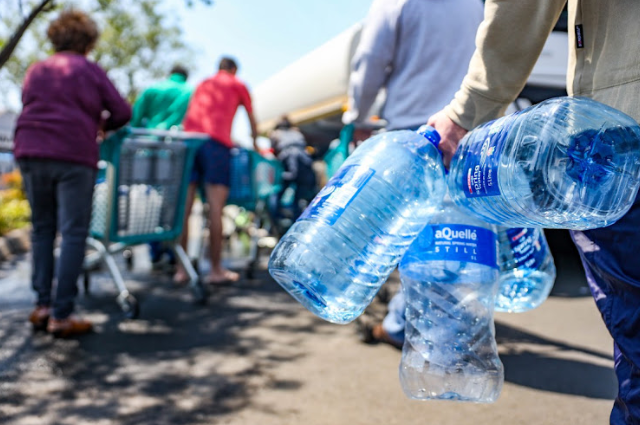
Dry taps have become a daily reality for many Johannesburg residents, as the city loses more than a third of its water supply, an estimated 655 million litres a day, to burst and ageing pipes.
Among those affected is 17-year-old student Thandani Masangu, whose block in Hillbrow has been without running water for more than three years. He described spending hours wheeling empty containers through the neighbourhood in search of a supply, only to be turned away from a municipal water truck reserved for an adjacent tower block.
With local elections expected by November, water shortages have become a flashpoint symbolising broader municipal failures, fuelling voter frustration and weakening support for the ruling African National Congress.
Wealthier residents have increasingly begun bypassing the municipal system altogether, drilling private boreholes, a shift that further reduces revenue the utility needs to fund repairs.
Johannesburg Water, the city-owned utility, acknowledges the scale of the problem. Zakhele Khuzwayo, the utility's senior manager for innovation and technology, said much of the city's infrastructure is more than 50 years old, and that officials are aware of where improvements are needed but still working out how to get there.
Craig Sheridan, director of the Centre in Water Research and Development at the University of the Witwatersrand, who compiled the data on the city's water losses, said routine maintenance tends to lose out to more visible spending priorities, a pattern he said extends across South Africa's public infrastructure more broadly. Analysts also point to climate change as a compounding factor, with rising temperatures increasing water lost to evaporation.
The crisis comes against the backdrop of a deepening budget crisis at the City of Johannesburg. In July, the National Treasury withheld funding from the city, which accounts for more than a sixth of South Africa's GDP, after repeated failures to meet financial management requirements. Treasury has said the city's latest R97.1 billion budget is unfunded, with planned spending, including wage increases, exceeding realistic revenue projections. A spokesperson for Johannesburg mayor Dada Morero did not respond to a request for comment, though Morero was quoted last month attributing unpaid municipal debts to payment system glitches.
The ANC has faced electoral consequences over service delivery failures before. In the 2021 local elections, public anger over similar issues pushed the party's national vote share below 50% for the first time since the end of apartheid, a decline that continued into the 2024 national elections, when the ANC lost its outright majority.
Some residents affected by the crisis say it will shape how they vote. Lindiwe Ndlovu, a 53-year-old former ANC member and Hillbrow flat owner, said she and several neighbours were cut off from the water supply in 2019 over non-payment, despite disputing the utility's usage estimates, which they say were based on a broken meter that was never replaced. A court ordered the utility to restore their supply in May, but this had not yet happened by the time of reporting. Khuzwayo said he could not comment on individual cases, but acknowledged the utility was struggling to keep pace with demand.
Meanwhile, in wealthier suburbs, residents have turned to private solutions, drilling boreholes alongside solar panel installations and arrangements with private waste collectors. Albertus Lombaard of the Borehole Water Association estimates that around 10,000 boreholes have been drilled across Gauteng province, which includes both Johannesburg and Pretoria, over the past decade. Litigation lawyer Thea Kilian said she spent R100,000 on a borehole, tanks and filters after a particularly disruptive shutdown, and admitted the water crisis no longer affects her personally, despite feeling for those who remain without reliable access.
SOURCE LINK: Reuters