 View notices
Economy contracts 0.2% in Q2 as mining, manufacturing weigh on growth

South Africa's economy contracted by 0.2% in the second quarter, reversing the 0.4% growth recorded in the first three months of the year, according to figures released by Statistics South Africa on Tuesday.
It was the first contraction since the third quarter of 2024, when GDP fell 0.3%. Three industries contracted during the quarter, led by mining, which shrank 3%, while manufacturing declined 1.8% and trade, catering and accommodation fell 1.9%. Trade and manufacturing were the biggest drags on overall growth, each shaving 0.2 of a percentage point off GDP, while mining subtracted 0.1 of a percentage point.
Agriculture, which had been expected to provide some support, grew 0.3%, while electricity, gas and water increased 1% and transport grew 0.9%.
On the expenditure side, household spending rose 0.4%, but net exports knocked 1.1 percentage points off GDP as imports rose considerably faster than exports.
Ahead of the release, PSG senior economist Johann Els had expected the economy to be broadly flat or contract by as much as 0.2% quarter-on-quarter, describing the high-frequency data available for the second quarter as a “mixed bag”.
“Mining and manufacturing were very weak, but consumers have held up reasonably well,” Els said.
He added that the quarter was the first full three-month period to reflect the oil shock and higher petrol prices, while the May interest rate hike added further pressure. He had expected agriculture to provide some support from the record maize crop, although some of that benefit could shift into the third quarter.
Els said the outcome was unlikely to derail the improvement expected for the full year. “This is not as weak as previously feared and would still leave the economy on track for around 1.4 to 1.6% growth this year, up from 1.1% in 2025. We'll wait for the details before changing our forecasts,” he said.
More recent data suggests economic activity improved after the end of the second quarter. The PayInc Economic Index rose 0.3% in July, recovering some of the ground lost after declines of 2% in May and 0.9% in June. At 102.7, the index was 0.9% higher than a year earlier.
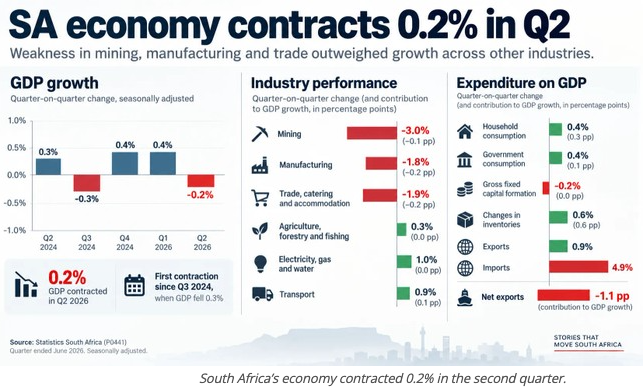 Photo: Stats SA
Shergeran Naidoo, head of stakeholder engagement at PayInc, said that while the broader environment remained difficult, the July index showed economic activity had regained some momentum. Payment activity provided a further positive signal, with transaction volumes reaching a record high and rising 13.5% year-on-year, while the value of electronic payments also increased during the month.
Independent economist Elize Kruger cautioned against reading too much into the improvement.
“July offered a welcome improvement, but one month does not yet signal a sustained turnaround,” she said.
“A more meaningful recovery will depend on greater stability, easing cost pressures and an improvement in confidence that encourages households to spend and businesses to invest and create jobs.”
The labour market also weakened during the second quarter, with the official unemployment rate rising to a four-year high of 33.6%, up from 32.7% in the first quarter, according to the same Stats SA data.
The number of unemployed people increased by 345,000 quarter-on-quarter to 8.5 million, while employment fell by 16,000 to 16.7 million. The formal sector shed 41,000 jobs during the quarter.