 View notices
Building collapses expose serious regulatory failures – Macpherson
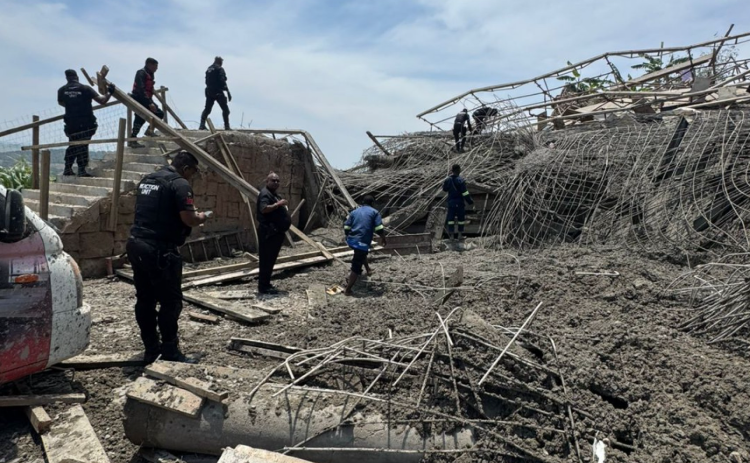
A series of deadly building collapses has exposed serious weaknesses in South Africa’s construction and regulatory system, including unlawful construction, weak enforcement, poor municipal oversight and failures in professional accountability, Public Works and Infrastructure Minister Dean Macpherson said on Thursday.
Macpherson was speaking in Pretoria after releasing Council for the Built Environment (CBE) investigations into four incidents in Verulam, Doornkop, Sea Point and Ormonde that killed 17 people and injured 24 between December 2025 and March 2026.
Wendy Dondolo reports for ANA that the most serious regulatory failures were found at the River Range Ranch Temple site in Redcliffe, Verulam, where a five-storey building collapsed on December 12, killing five people and injuring 11.
The investigation found no approved building plans or construction work permit, while no built-environment professionals responsible for the design and supervision could be identified. Investigators also found no complete structural drawings and could not conclusively determine a single technical cause of the collapse.
The CBE described the incident as a case of ignoring the law, with Macpherson warning that a building of that scale should not have been able to progress without regulatory approval and professional oversight.
In Doornkop, Soweto, three members of one family were killed when a residential structure collapsed following heavy rainfall. Investigators found that the property was on high-risk dolomitic land and concluded that a shallow sinkhole was the most probable cause.
The investigation found that authorities had known about the danger for decades and had previously relocated residents from the area, but part of the original structure remained and was later occupied by another family. The CBE characterised the incident as a failure to enforce the law.
At the Magnolia development in Sea Point, temporary formwork collapsed on February 17, injuring four workers. The permanent structure did not fail, but investigators found that incomplete and uninspected construction had been prematurely loaded.
Although the development had complied with planning requirements and appointed the necessary professionals, the incident highlighted the need for safety controls to be implemented on site rather than merely recorded on paper.
The most serious technical and professional concerns emerged from the Ormonde industrial building collapse in Johannesburg on March 2, which killed nine workers and injured six.
The collapse occurred while concrete topping was being placed on suspended floors. Investigators found significant deficiencies in the structural steelwork supporting the floors and concluded that the beams and columns had effectively no capacity to carry the additional construction load.
No application for building approval had been submitted to the City of Johannesburg before the collapse, while concerns were also raised about professional engineering arrangements, including the involvement of an engineer previously deregistered by the Engineering Council of South Africa. The CBE described Ormonde as a “disaster waiting to happen”.
Macpherson said the investigations pointed to inconsistent implementation of construction legislation rather than an absence of laws. He identified inadequate oversight, weak enforcement and non-compliance as the central problems.
The reports recommend stronger information-sharing between municipalities, the Department of Employment and Labour, the National Home Builders Registration Council, professional councils and other regulators, as well as tougher sanctions for owners, developers, contractors and professionals who breach statutory requirements.
Macpherson said the findings would be referred to municipalities, professional councils, national departments and law-enforcement authorities where appropriate. He stressed that the reports did not determine criminal or civil liability, which would remain the responsibility of investigative authorities, professional disciplinary bodies and the courts.
The minister said the findings should lead to a stronger system capable of identifying and addressing construction risks before buildings fail, with the safety of workers and the public remaining the priority.