 View notices
Beneath the hops and froth: what SAB's beer sales reveal about SA's economy
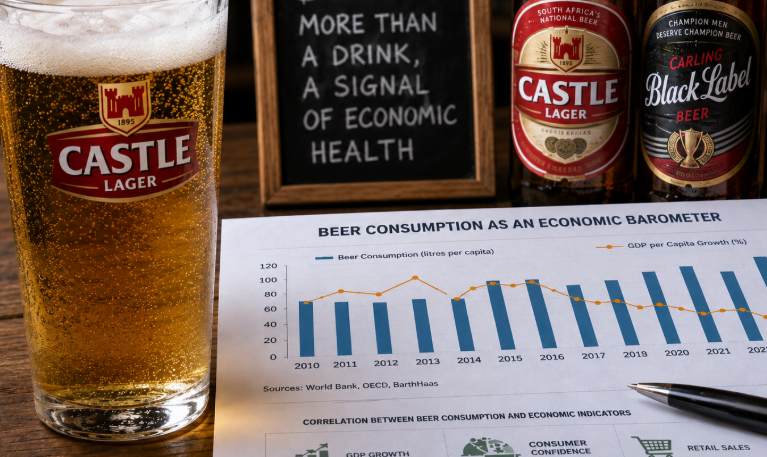
South African Breweries' affordable beer volumes are falling – and investors should not dismiss that as a brewing blip. Beneath the hops and froth lies a better barometer of financial strain than another backward-looking retail-sales print.
A beer bought from a township shop or local tavern occupies an unusually revealing place in the consumer budget. It is neither a staple nor a large-ticket discretionary purchase – it is a small, habitual release valve, precisely the sort of expenditure households cut when the arithmetic between income, food, electricity, transport and debt repayments stops working.
SAB says cost pressures are weighing on its affordable brands, even as premium beer remains resilient.
The temptation is to treat this as a narrow, company-specific issue – a volume problem for AB InBev's South African operation, perhaps mitigated by price, mix and premiumisation. Yet the divergence between its affordable and premium brands points to something broader: a bifurcated consumer, where households with spending power are still trading up while those at the affordable end are cutting back altogether.
Nominal retail sales may hold up through higher prices and premium demand, but falling affordable-beer sales are a decent measure of how much room is left in the South African household budget once essentials are paid for.
South African consumer analysis is too often framed as a debate about interest-rate relief. But rate cuts may ease debt repayments only for those who can already service debt – lower-income households must first contend with food, electricity and transport costs.
Until those pressures recede, cheaper credit is unlikely to translate fully into higher discretionary spending. For consumer companies, pricing and mix can cushion weaker volumes only temporarily; eventually, affordability limits pricing power, and volume pressure reaches margins.
A dry Western Cape adds a new risk
The Western Cape's driest July in decades raises the risk of a difficult summer for the province's high-value fruit and vegetable producers. It is not yet a food-inflation forecast, but lower water availability could mean weaker yields, higher irrigation costs and tighter fresh-produce supply – with the impact reaching consumers over time.
Unlike staples, fresh food offers households little scope to trade down, potentially adding to the pressure already evident in SAB's affordable-beer volumes.
The offset is that food inflation has eased sharply: food and non-alcoholic beverage inflation slowed to 1.6% in June, from 5.7% a year earlier, helped by lower cereal prices and cheaper maize meal and rice. That is meaningful relief in a category that makes up 18.23% of the CPI basket, but it does not undo the cumulative squeeze on household budgets.
For markets, the risk is an increasingly uneven inflation picture – staple disinflation alongside renewed fresh-produce pressure, should dry conditions persist. That would leave the SARB balancing a consumer in need of relief against an inflation outlook still exposed to supply shocks.
With headline inflation at 5% in June and the repo rate held at 7% in July, the case for a smooth, uninterrupted easing cycle remains far from settled.
What this means for positioning
For South African equities, SAB's affordable-volume weakness argues against a broad lower-end consumer recovery trade. The better opportunities are likely to be businesses serving premium consumers, offering clear value, or selling non-discretionary goods, rather than relying on volume growth from stretched households.
Food retailers and processors require a more selective view. Cheaper grain inputs may support margins and value-led demand, while a dry Western Cape summer could lift fresh-produce costs and disrupt supply. Diversified sourcing, efficient logistics and scale will matter.
For fixed income, food disinflation supports eventual easing, but a weather-related fresh-food shock could delay it. With headline inflation at 5% and the repo rate still at 7%, investors should be wary of positioning too aggressively for a smooth rate-cutting cycle.
So, the next time you take a sip of a reasonably priced lager, spare a thought for the volume data behind it. Falling affordable-beer sales are more than a minor brewing statistic – they offer a useful measure of how much room remains in the South African household budget once the essentials are paid for.
With consumers splitting between those still able to trade up and those cutting back, and food inflation vulnerable to a weather-driven twist, the real consumer signal may not be found in the retail-sales release, but somewhere beneath the hops and froth.