 View notices
Tutankhamun's ancient trumpets: the 1939 broadcast that nearly ended in disaster
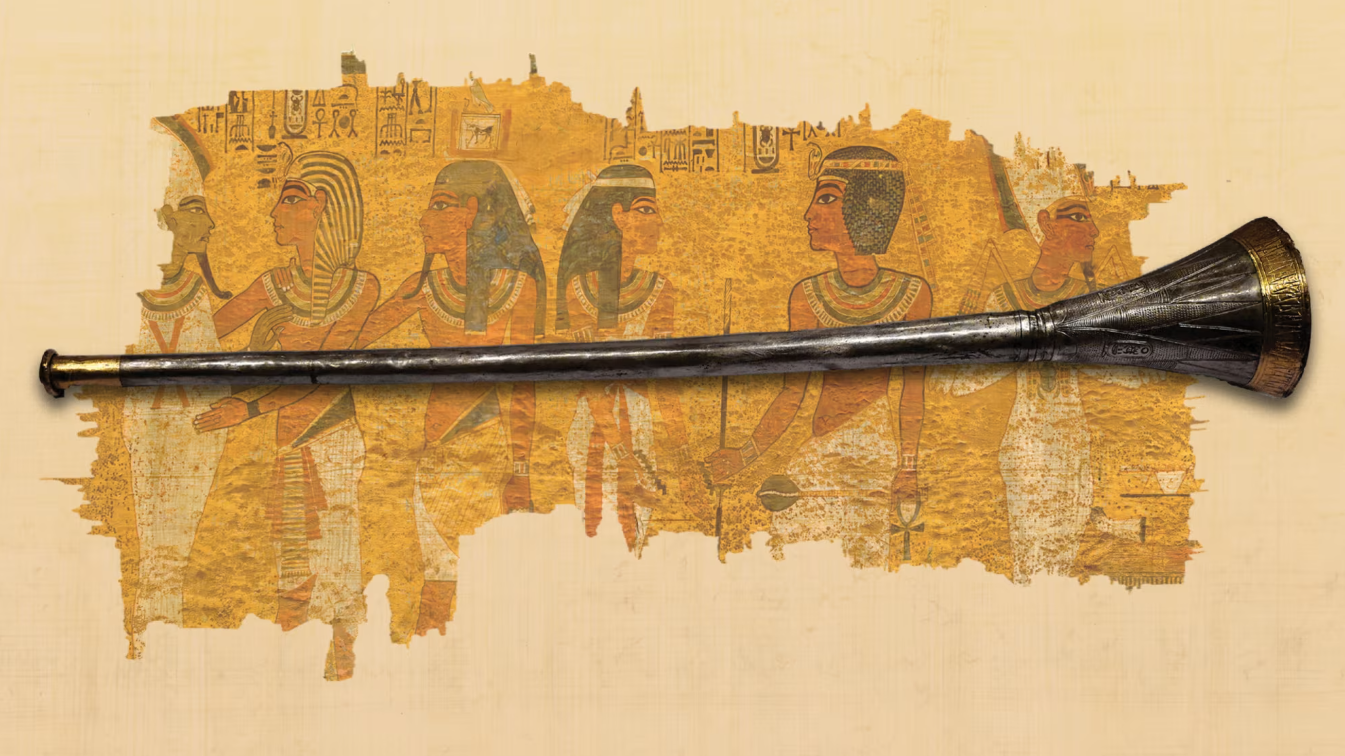
In April 1939, an estimated 150 million listeners around the world tuned in to a BBC radio broadcast in which two ancient trumpets, discovered in Tutankhamun's tomb more than a decade earlier, were sounded live from the Egyptian Museum in Cairo.
It remains, to this day, the oldest surviving metal trumpets in existence being played on air.
Salima Ikram, professor of Egyptology at the American University in Cairo, described the recording as an auditory and sensory bridge between the era of Tutankhamun and the present day.
The instruments, one silver and one thought to be bronze or copper, are believed to have originally been used in royal processions, with ancient Egyptian art depicting trumpets in military, religious and ceremonial contexts.
Their fluted ends are decorated with floral motifs and depictions of Egyptian gods, and Ikram suggested the pairing of a brassy trumpet with a silver one may symbolise day and night, echoing the pharaoh's journey from this world to the next.
The broadcast very nearly did not happen. During rehearsals, a modern mouthpiece fitted to the silver trumpet caused it to shatter when played.
Archaeologist Alfred Lucas, who had been part of Howard Carter's excavation team and was present at the time, was reportedly hospitalised from the shock. Despite this, the team attempted the recording again once the instrument had been repaired.
Shortly before the broadcast, the museum lost power, forcing the session to be conducted by candlelight. World War II broke out only months later, which some took as confirmation of the supposed Tutankhamun curse, an idea Ikram firmly rejected.
Because of their fragility, the trumpets are now considered too delicate ever to be played again. Ikram suggested a replica might ideally have been used for the original test, noting that the experience taught a valuable lesson about handling irreplaceable artefacts.
The trumpets are now housed in the newly opened Grand Egyptian Museum, near the Pyramids of Giza, where they are kept in climate-controlled displays alongside their original wooden cores.
Curator Jasmien Abdalraouf explained that the display must maintain a temperature of between 18 and 22 degrees Celsius to preserve both the metal and the organic wood. Security is a major consideration too, given that one of the trumpets was stolen from the Egyptian Museum in Cairo during the 2011 uprising, before being recovered weeks later at a metro station.
Journalist and archaeologist Christine Finn drew a comparison with the recent loan of the Bayeux tapestry from France to the British Museum, a move that drew criticism from parts of the French art world and was described as "madness" by the late artist David Hockney.
Finn argued that such episodes, including the cracked trumpet and the power failure during the original broadcast, serve as reminders of the fragility of historical artefacts, and warned against museum experiences becoming too polished or artificial in an age of digital access.
She noted that even if the instruments themselves can never be played again, the sound of the trumpets may now endure indefinitely thanks to the surviving recording.
PHOTO BY In April 1939, an estimated 150 million listeners around the world tuned in to a BBC radio broadcast in which two ancient trumpets, discovered in Tutankhamun's tomb more than a decade earlier, were sounded live from the Egyptian Museum in Cairo.
It remains, to this day, the oldest surviving metal trumpets in existence being played on air.
Salima Ikram, professor of Egyptology at the American University in Cairo, described the recording as an auditory and sensory bridge between the era of Tutankhamun and the present day.
The instruments, one silver and one thought to be bronze or copper, are believed to have originally been used in royal processions, with ancient Egyptian art depicting trumpets in military, religious and ceremonial contexts.
Their fluted ends are decorated with floral motifs and depictions of Egyptian gods, and Ikram suggested the pairing of a brassy trumpet with a silver one may symbolise day and night, echoing the pharaoh's journey from this world to the next.
The broadcast very nearly did not happen. During rehearsals, a modern mouthpiece fitted to the silver trumpet caused it to shatter when played.
Archaeologist Alfred Lucas, who had been part of Howard Carter's excavation team and was present at the time, was reportedly hospitalised from the shock. Despite this, the team attempted the recording again once the instrument had been repaired.
Shortly before the broadcast, the museum lost power, forcing the session to be conducted by candlelight. World War II broke out only months later, which some took as confirmation of the supposed Tutankhamun curse, an idea Ikram firmly rejected.
Because of their fragility, the trumpets are now considered too delicate ever to be played again. Ikram suggested a replica might ideally have been used for the original test, noting that the experience taught a valuable lesson about handling irreplaceable artefacts.
The trumpets are now housed in the newly opened Grand Egyptian Museum, near the Pyramids of Giza, where they are kept in climate-controlled displays alongside their original wooden cores.
Curator Jasmien Abdalraouf explained that the display must maintain a temperature of between 18 and 22 degrees Celsius to preserve both the metal and the organic wood. Security is a major consideration too, given that one of the trumpets was stolen from the Egyptian Museum in Cairo during the 2011 uprising, before being recovered weeks later at a metro station.
Journalist and archaeologist Christine Finn drew a comparison with the recent loan of the Bayeux tapestry from France to the British Museum, a move that drew criticism from parts of the French art world and was described as "madness" by the late artist David Hockney.
Finn argued that such episodes, including the cracked trumpet and the power failure during the original broadcast, serve as reminders of the fragility of historical artefacts, and warned against museum experiences becoming too polished or artificial in an age of digital access.
She noted that even if the instruments themselves can never be played again, the sound of the trumpets may now endure indefinitely thanks to the surviving recording.
In April 1939, an estimated 150 million listeners around the world tuned in to a BBC radio broadcast in which two ancient trumpets, discovered in Tutankhamun's tomb more than a decade earlier, were sounded live from the Egyptian Museum in Cairo.
It remains, to this day, the oldest surviving metal trumpets in existence being played on air.
Salima Ikram, professor of Egyptology at the American University in Cairo, described the recording as an auditory and sensory bridge between the era of Tutankhamun and the present day.
The instruments, one silver and one thought to be bronze or copper, are believed to have originally been used in royal processions, with ancient Egyptian art depicting trumpets in military, religious and ceremonial contexts.
Their fluted ends are decorated with floral motifs and depictions of Egyptian gods, and Ikram suggested the pairing of a brassy trumpet with a silver one may symbolise day and night, echoing the pharaoh's journey from this world to the next.
The broadcast very nearly did not happen. During rehearsals, a modern mouthpiece fitted to the silver trumpet caused it to shatter when played.
Archaeologist Alfred Lucas, who had been part of Howard Carter's excavation team and was present at the time, was reportedly hospitalised from the shock. Despite this, the team attempted the recording again once the instrument had been repaired.
Shortly before the broadcast, the museum lost power, forcing the session to be conducted by candlelight. World War II broke out only months later, which some took as confirmation of the supposed Tutankhamun curse, an idea Ikram firmly rejected.
Because of their fragility, the trumpets are now considered too delicate ever to be played again. Ikram suggested a replica might ideally have been used for the original test, noting that the experience taught a valuable lesson about handling irreplaceable artefacts.
The trumpets are now housed in the newly opened Grand Egyptian Museum, near the Pyramids of Giza, where they are kept in climate-controlled displays alongside their original wooden cores.
Curator Jasmien Abdalraouf explained that the display must maintain a temperature of between 18 and 22 degrees Celsius to preserve both the metal and the organic wood. Security is a major consideration too, given that one of the trumpets was stolen from the Egyptian Museum in Cairo during the 2011 uprising, before being recovered weeks later at a metro station.
Journalist and archaeologist Christine Finn drew a comparison with the recent loan of the Bayeux tapestry from France to the British Museum, a move that drew criticism from parts of the French art world and was described as "madness" by the late artist David Hockney.
Finn argued that such episodes, including the cracked trumpet and the power failure during the original broadcast, serve as reminders of the fragility of historical artefacts, and warned against museum experiences becoming too polished or artificial in an age of digital access.
She noted that even if the instruments themselves can never be played again, the sound of the trumpets may now endure indefinitely thanks to the surviving recording.
PHOTO CREDIT: In April 1939, an estimated 150 million listeners around the world tuned in to a BBC radio broadcast in which two ancient trumpets, discovered in Tutankhamun's tomb more than a decade earlier, were sounded live from the Egyptian Museum in Cairo.
It remains, to this day, the oldest surviving metal trumpets in existence being played on air.
Salima Ikram, professor of Egyptology at the American University in Cairo, described the recording as an auditory and sensory bridge between the era of Tutankhamun and the present day.
The instruments, one silver and one thought to be bronze or copper, are believed to have originally been used in royal processions, with ancient Egyptian art depicting trumpets in military, religious and ceremonial contexts.
Their fluted ends are decorated with floral motifs and depictions of Egyptian gods, and Ikram suggested the pairing of a brassy trumpet with a silver one may symbolise day and night, echoing the pharaoh's journey from this world to the next.
The broadcast very nearly did not happen. During rehearsals, a modern mouthpiece fitted to the silver trumpet caused it to shatter when played.
Archaeologist Alfred Lucas, who had been part of Howard Carter's excavation team and was present at the time, was reportedly hospitalised from the shock. Despite this, the team attempted the recording again once the instrument had been repaired.
Shortly before the broadcast, the museum lost power, forcing the session to be conducted by candlelight. World War II broke out only months later, which some took as confirmation of the supposed Tutankhamun curse, an idea Ikram firmly rejected.
Because of their fragility, the trumpets are now considered too delicate ever to be played again. Ikram suggested a replica might ideally have been used for the original test, noting that the experience taught a valuable lesson about handling irreplaceable artefacts.
The trumpets are now housed in the newly opened Grand Egyptian Museum, near the Pyramids of Giza, where they are kept in climate-controlled displays alongside their original wooden cores.
Curator Jasmien Abdalraouf explained that the display must maintain a temperature of between 18 and 22 degrees Celsius to preserve both the metal and the organic wood. Security is a major consideration too, given that one of the trumpets was stolen from the Egyptian Museum in Cairo during the 2011 uprising, before being recovered weeks later at a metro station.
Journalist and archaeologist Christine Finn drew a comparison with the recent loan of the Bayeux tapestry from France to the British Museum, a move that drew criticism from parts of the French art world and was described as "madness" by the late artist David Hockney.
Finn argued that such episodes, including the cracked trumpet and the power failure during the original broadcast, serve as reminders of the fragility of historical artefacts, and warned against museum experiences becoming too polished or artificial in an age of digital access.
She noted that even if the instruments themselves can never be played again, the sound of the trumpets may now endure indefinitely thanks to the surviving recording.
In April 1939, an estimated 150 million listeners around the world tuned in to a BBC radio broadcast in which two ancient trumpets, discovered in Tutankhamun's tomb more than a decade earlier, were sounded live from the Egyptian Museum in Cairo.
It remains, to this day, the oldest surviving metal trumpets in existence being played on air.
Salima Ikram, professor of Egyptology at the American University in Cairo, described the recording as an auditory and sensory bridge between the era of Tutankhamun and the present day.
The instruments, one silver and one thought to be bronze or copper, are believed to have originally been used in royal processions, with ancient Egyptian art depicting trumpets in military, religious and ceremonial contexts.
Their fluted ends are decorated with floral motifs and depictions of Egyptian gods, and Ikram suggested the pairing of a brassy trumpet with a silver one may symbolise day and night, echoing the pharaoh's journey from this world to the next.
The broadcast very nearly did not happen. During rehearsals, a modern mouthpiece fitted to the silver trumpet caused it to shatter when played.
Archaeologist Alfred Lucas, who had been part of Howard Carter's excavation team and was present at the time, was reportedly hospitalised from the shock. Despite this, the team attempted the recording again once the instrument had been repaired.
Shortly before the broadcast, the museum lost power, forcing the session to be conducted by candlelight. World War II broke out only months later, which some took as confirmation of the supposed Tutankhamun curse, an idea Ikram firmly rejected.
Because of their fragility, the trumpets are now considered too delicate ever to be played again. Ikram suggested a replica might ideally have been used for the original test, noting that the experience taught a valuable lesson about handling irreplaceable artefacts.
The trumpets are now housed in the newly opened Grand Egyptian Museum, near the Pyramids of Giza, where they are kept in climate-controlled displays alongside their original wooden cores.
Curator Jasmien Abdalraouf explained that the display must maintain a temperature of between 18 and 22 degrees Celsius to preserve both the metal and the organic wood. Security is a major consideration too, given that one of the trumpets was stolen from the Egyptian Museum in Cairo during the 2011 uprising, before being recovered weeks later at a metro station.
Journalist and archaeologist Christine Finn drew a comparison with the recent loan of the Bayeux tapestry from France to the British Museum, a move that drew criticism from parts of the French art world and was described as "madness" by the late artist David Hockney.
Finn argued that such episodes, including the cracked trumpet and the power failure during the original broadcast, serve as reminders of the fragility of historical artefacts, and warned against museum experiences becoming too polished or artificial in an age of digital access.
She noted that even if the instruments themselves can never be played again, the sound of the trumpets may now endure indefinitely thanks to the surviving recording.