 View notices
Police turn to AI to find stolen art hiding in plain sight
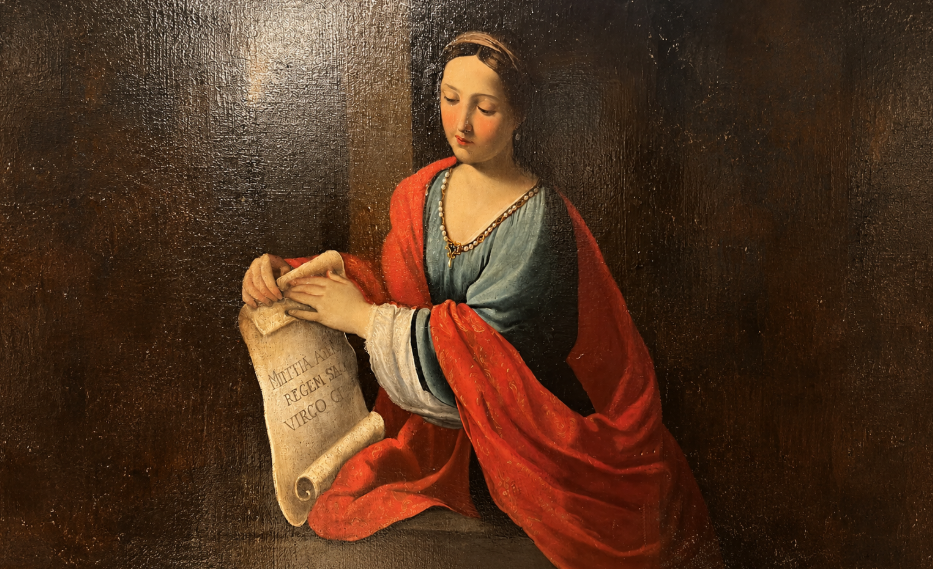
Police worldwide are struggling to keep pace with a rise in art theft.
But AI software can now sniff out even the most cleverly disguised artworks, Sofia Quaglia reports for the BBC.
During a routine visit to the annual antiquity fair in Parma, Italy, in October 2024, police officers busily snapped photos of the artworks as they walked between the stands. It wasn’t art appreciation – it was detective work.
The images were uploaded to an internal database, and a couple of hours later the system flagged one of them: a painting of a young, fair-skinned woman in aquamarine and red, holding a half-unravelled parchment scroll.
Officers seized the work the next day. It was Saint Agnese, stolen from a church near Naples in 2004, and thieves had disguised it by painting over the saint’s lamb to turn it into a scroll.
Lt Col Salvatore Rapicavoli of the Carabinieri’s cultural heritage unit said the software matches colour, outline and composition rather than keywords, and has brought an exponential rise in the number of hits.
The system, called Swoads (Stolen Works of Art Detection System), has been in use since November 2023 and has helped the force recover more than 300 large paintings and statues and over 165,000 smaller objects, worth more than €203m, according to a summary of the BBC report in “The Week in Art.”
Because so much time had passed, the antiques dealer who had the painting, who had probably inherited it without knowing its history, was not prosecuted, and the work was returned to the church for restoration.
Experts caution that the technology is no silver bullet. Timothy Carpenter, the former head of the FBI’s Art Crime Team, said the software cannot replace human analysis and that following up its leads takes a large dedicated team.
Italy’s art crime unit has about 300 people, he noted, against 24 at the FBI team’s largest. Criminals can also use AI to alter images or fabricate provenance.
Sources: BBC, October; The Week in Art; Boing Boing.