 View notices
New stage play revisits Liberace's hidden private life
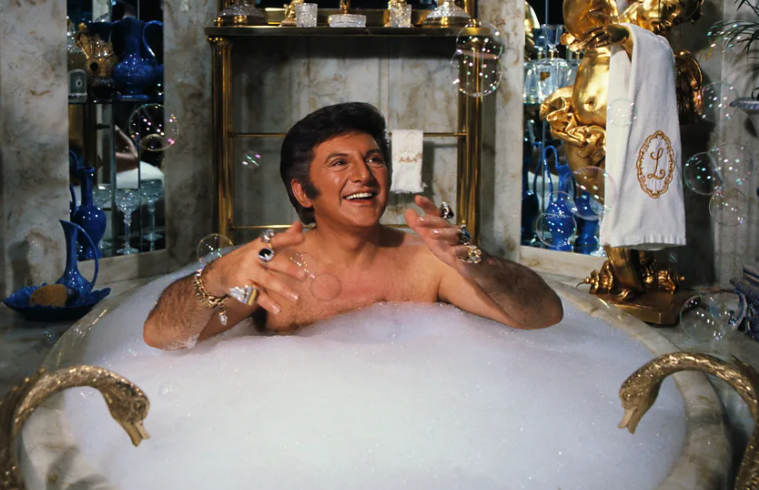
A new stage production about the pianist and entertainer Liberace, I'll Be Seeing You, opens this month in Scotland, examining the gap between his flamboyant public persona and the private life he concealed for decades, Nick Levine writes for the BBC.
Liberace – born Władziu Valentino Liberace in Wisconsin in May 1919 to a musical, working-class family – began piano lessons at four and was performing professionally by 13.
He made his debut with the Chicago Symphony Orchestra in January 1940, playing Liszt, before turning towards popular entertainment through the 1940s, blending classical technique with sentimental and jazz standards.
During his 1950s-to-1970s heyday he styled himself a “one-man Disneyland” and was widely – if unverifiably – billed as the world's highest-paid entertainer, cultivating an image of outrageous wealth that culminated, at his final Radio City Music Hall residency in 1985, in an entrance from a giant Fabergé egg replica wearing a cape of pink turkey feathers.
He died in February 1987 of an Aids-related illness, having learned of his HIV status around 18 months earlier without disclosing it publicly. He never confirmed he was gay, and in 1959 successfully sued the Daily Mirror for libel after it strongly implied as much, winning £8,000 in damages – equivalent to roughly £167,000 today.
Actor Simon Russell Beale, who plays Liberace in the new production, told the BBC that the case was a considerable gamble that could have ended his career had he lost, and that Liberace's insistence under oath that he opposed homosexuality was simply part of a broader pattern of evasion about his sexuality.
Author Vincent L Stephens, who wrote about Liberace in Rocking the Closet, told the BBC that the court victory emboldened the performer, who became markedly more flamboyant afterwards, including hiring a succession of chauffeurs to drive him on stage in his signature Rolls-Royce.
One such driver, Scott Thorson, sued Liberace for $113 million in palimony in 1982, alleging he had been left penniless after their five-year relationship ended abruptly; Liberace denied being gay and denied Thorson had been his lover. The case was settled in 1986, with Thorson receiving $75,000 in cash along with three cars and three dogs.
Thorson's 1988 memoir was later adapted into the Emmy-winning film Behind the Candelabra, starring Michael Douglas and Matt Damon, which Liberace's former musical director Bo Ayars told the BBC succeeded in capturing his idiosyncrasies as a person and performer – including his determination to maintain appearances through extensive cosmetic surgery, and a hairpiece Ayars said he never once saw him without.
Beale said he was drawn to how Liberace is remembered as a cultural figure, having often been dismissed in his lifetime as a “vulgar joke” despite a level of musicianship he felt was rarely credited. Both Beale and Ayars pushed back on the idea of Liberace as simply a tragic, closeted figure, describing instead a driven performer – who, with Ayars, gave around 5,000 shows, often twice nightly – whom friends recalled as warm, generous and largely content with the trade-offs he had made to protect his career.
The play's Scottish run coincides with the continued touring success of Liberace & Liza, a separate cabaret tribute act pairing affectionate parodies of Liberace and Liza Minnelli, built on the fiction that the two – who likely never met – were close collaborators.