 View notices
Market Theatre revisits Dublin weekend that shaped the Bill of Rights
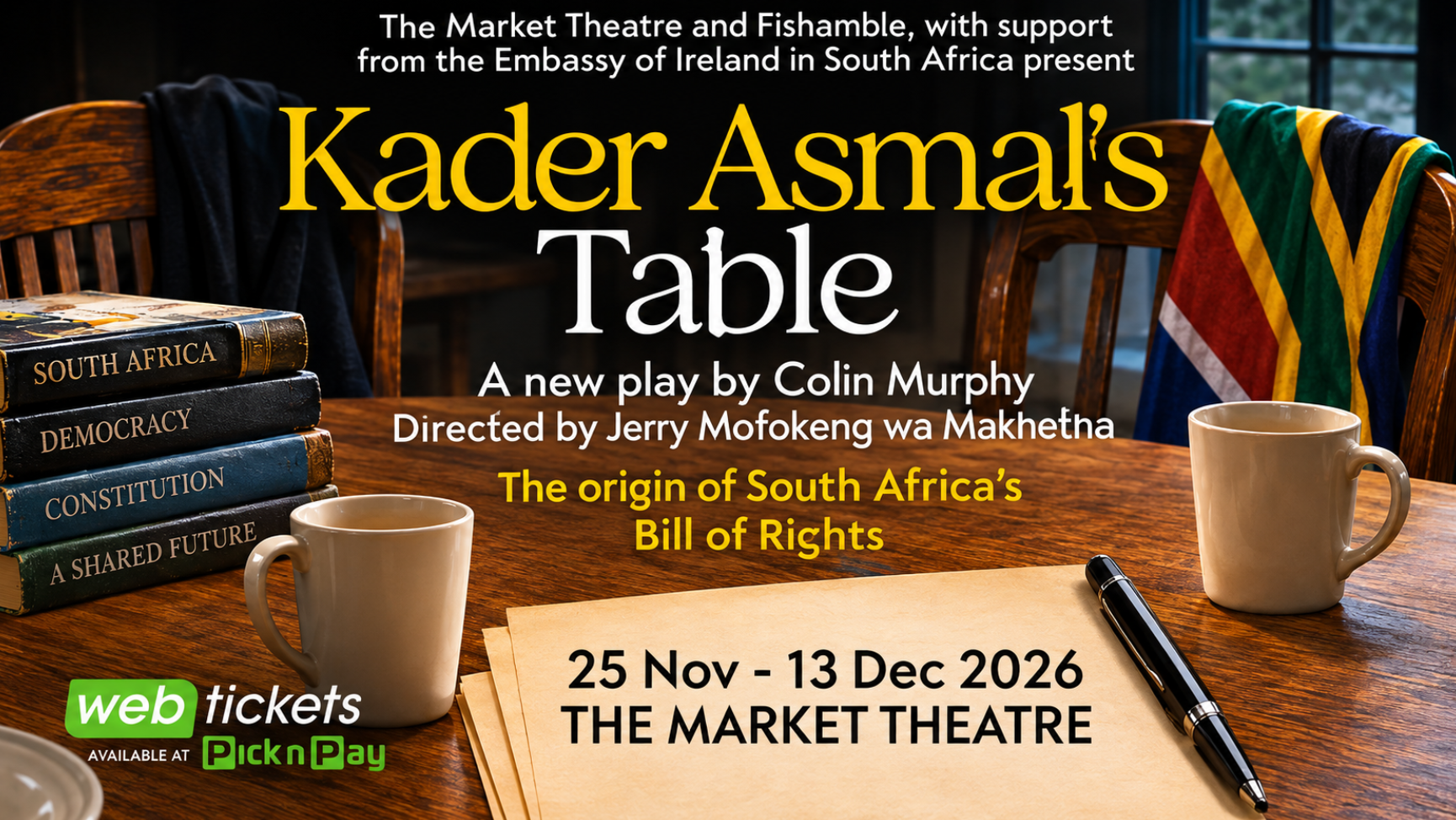
Kader Asmal’s Table, a historical drama exploring the origins of South Africa’s Bill of Rights, runs at the Market Theatre from 25 November to 13 December.
The new work by the Irish playwright Colin Murphy is a co-production between the Market Theatre and Fishamble in Dublin, supported by Ireland’s Department of Foreign Affairs and Trade and the Embassy of Ireland in South Africa.
It is the anchor piece of Common Ground, a week of theatre, talks, screenings and exhibitions on the shared stories, history and people of the two countries.
A play within a play, it offers a fictional account of a rainy Dublin weekend in 1988, when the human rights activists Kader Asmal and Albie Sachs were tasked by OR Tambo and the ANC with beginning the process of writing a Bill of Rights for a South Africa that did not yet exist. The weekend came shortly after Sachs survived a car bomb in Mozambique that cost him his right arm and the sight in one eye.
Both men sat on the ANC’s Constitutional Committee. Nelson Mandela later appointed Sachs among the founding justices of the Constitutional Court, while Asmal served in the Mandela and Thabo Mbeki cabinets, most notably as minister of education from 1999 to 2004.
The production marks 30 years since the adoption of the Constitution. Its director, Jerry Mofokeng wa Makhetha, said the play gives a human face to a moment many called a miracle, but is not frozen in time.
He said it stresses that democracy came through sacrifice, with 1994 a miraculous diversion from a possible civil war, and that the cast moves beyond the romantic myth of two exiles imagining a constitution, instead holding a mirror to today’s South Africa and asking what has become of the promise of a better life for all.
Murphy called the project a career high. He said a history play is never only about history, and that this one wrestles with imagining a constitution, with using theatre to interrogate political history, and with South Africa’s present challenges.
He said Ireland and South Africa share long and troubled histories of colonisation and decolonisation, and that the play gave him a bridge between them. He described it as a fictionalised imagining of the pair’s meeting and said he hoped it did them justice.
Greg Homann, artistic director of the Market Theatre Foundation, said the theatre was bringing home one of the least-told true stories of South Africa, one with almost mythological status. He said it reminds audiences why the principles were fought for and why they remain worth defending.
Tickets are available on Webtickets from R110, with discounts for the preview performance and for groups of four or more, and half-price tickets on Wednesdays.
*Source: [Artslink](Kader Asmal’s Table, a historical drama exploring the origins of South Africa’s Bill of Rights, runs at the Market Theatre from 25 November to 13 December 2026, Artslink reports.
The new work by the Irish playwright Colin Murphy is a co-production between the Market Theatre and Fishamble in Dublin, supported by Ireland’s Department of Foreign Affairs and Trade and the Embassy of Ireland in South Africa. It is the anchor piece of Common Ground, a week of theatre, talks, screenings and exhibitions on the shared stories, history and people of the two countries.
A play within a play, it offers a fictional account of a rainy Dublin weekend in 1988, when the human rights activists Kader Asmal and Albie Sachs were tasked by OR Tambo and the ANC with beginning the process of writing a Bill of Rights for a South Africa that did not yet exist. The weekend came shortly after Sachs survived a car bomb in Mozambique that cost him his right arm and the sight in one eye.
Both men sat on the ANC’s Constitutional Committee. Nelson Mandela later appointed Sachs among the founding justices of the Constitutional Court, while Asmal served in the Mandela and Thabo Mbeki cabinets, most notably as minister of education from 1999 to 2004.
The production marks 30 years since the adoption of the Constitution. Its director, Jerry Mofokeng wa Makhetha, said the play gives a human face to a moment many called a miracle, but is not frozen in time. He said it stresses that democracy came through sacrifice, with 1994 a miraculous diversion from a possible civil war, and that the cast moves beyond the romantic myth of two exiles imagining a constitution, instead holding a mirror to today’s South Africa and asking what has become of the promise of a better life for all.
Murphy called the project a career high. He said a history play is never only about history, and that this one wrestles with imagining a constitution, with using theatre to interrogate political history, and with South Africa’s present challenges. He said Ireland and South Africa share long and troubled histories of colonisation and decolonisation, and that the play gave him a bridge between them. He described it as a fictionalised imagining of the pair’s meeting and said he hoped it did them justice.
Greg Homann, artistic director of the Market Theatre Foundation, said the theatre was bringing home one of the least-told true stories of South Africa, one with almost mythological status. He said it reminds audiences why the principles were fought for and why they remain worth defending.
Tickets are available on Webtickets from R110, with discounts for the preview performance and for groups of four or more, and half-price tickets on Wednesdays.)
Source: Artslink