 View notices
Houthi strikes bring Saudi aviation to a standstill as Yemen war escalates
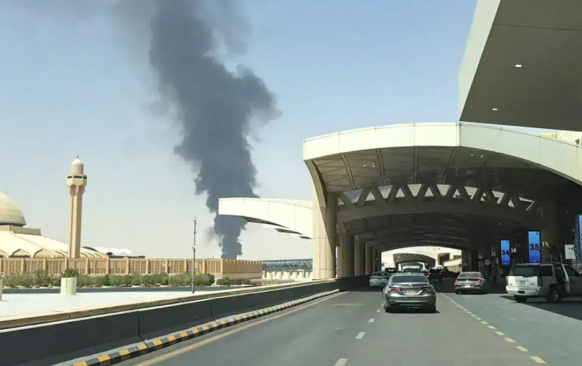
Saudi Arabia is facing one of its most serious security crises in years after repeated missile and drone attacks by Yemen’s Iran-backed Houthi movement killed at least 14 people at Riyadh’s international airport, injured hundreds and brought much of the kingdom’s aviation network to a standstill.
The attacks on King Khalid International Airport over the weekend have prompted widespread flight cancellations, international travel warnings and renewed concerns that the conflict in Yemen could develop into a broader regional confrontation. Reuters reported on Monday that the skies over Riyadh were largely empty after the attacks, with aviation analytics company Cirium estimating that about 60% of scheduled flights would be cancelled during the day.
The airport, Saudi Arabia’s second busiest after Jeddah, cancelled 99.7% of scheduled flights on Sunday. More than a third of flights across the kingdom were expected to be cancelled on Monday.
Saturday’s attack killed 13 people and wounded more than 300, while a further strike on Sunday killed one person and injured 11 others.
The Houthis claimed responsibility for the earlier attack and warned international airlines, airport employees and travellers to avoid Saudi airports and airspace, excluding airports serving the holy cities of Mecca and Medina.
Saudi authorities have launched an investigation into how missiles penetrated the country’s air defences and struck one of its most heavily protected aviation facilities.
The disruption has extended to international carriers, with Lufthansa suspending flights to Riyadh until 16 October and Air France-KLM extending its suspension until the end of the month.
The United States Federal Aviation Administration has also advised American airlines to exercise caution when flying into or over Saudi Arabia.
Schools in Riyadh have shifted to remote learning, while businesses have introduced precautionary measures as the security situation deteriorates.
Saudi strikes hit Yemen as fighting spreads
Saudi Arabia has responded with military operations against Houthi positions in Yemen, including airstrikes on the capital, Sanaa.
The Associated Press reported on Monday that strikes in the Houthi-controlled city had killed at least one person and wounded 12 others, including women and children, according to local health officials. Saudi forces have also reported intercepting cruise missiles and drones, including an unmanned aircraft over the kingdom’s Eastern Province.
The latest confrontation comes amid renewed fighting between Houthi forces and troops aligned with Yemen’s internationally recognised government, which is supported by Saudi Arabia.
The conflict has intensified around strategic territory in western Yemen, including areas near the Bab el-Mandeb Strait, the narrow maritime passage connecting the Red Sea with the Gulf of Aden.
The strait is one of the world’s most important shipping corridors, providing access to the Suez Canal and linking Asian and Middle Eastern trade routes with Europe.
Continued instability in the area threatens commercial shipping and could force more vessels to divert around the Cape of Good Hope, increasing voyage times, fuel consumption and freight costs.
Regional powers seek to contain conflict
The attacks have drawn condemnation from several regional governments, including Turkey, Pakistan and Egypt, while Iran has offered to facilitate diplomatic discussions between Saudi Arabia and the Houthis.
Al Jazeera reported on Monday that Iranian Foreign Minister Abbas Araqchi had urged a diplomatic approach during discussions with his Saudi counterpart, Prince Faisal bin Farhan.
Tehran maintains close ties with the Houthi movement, although the group operates independently within Yemen’s complicated political and military landscape.
The escalation has also unsettled Saudi Arabia’s business and energy sectors.
Reuters reported that several senior energy executives had been removed from the programme of the WPC Energy Congress in Riyadh following the attacks.
The congress is one of the international petroleum industry’s major gatherings, bringing together government representatives, energy companies and industry organisations.
Sources: Reuters, Associated Press, Al Jazeera, Sowetan.